
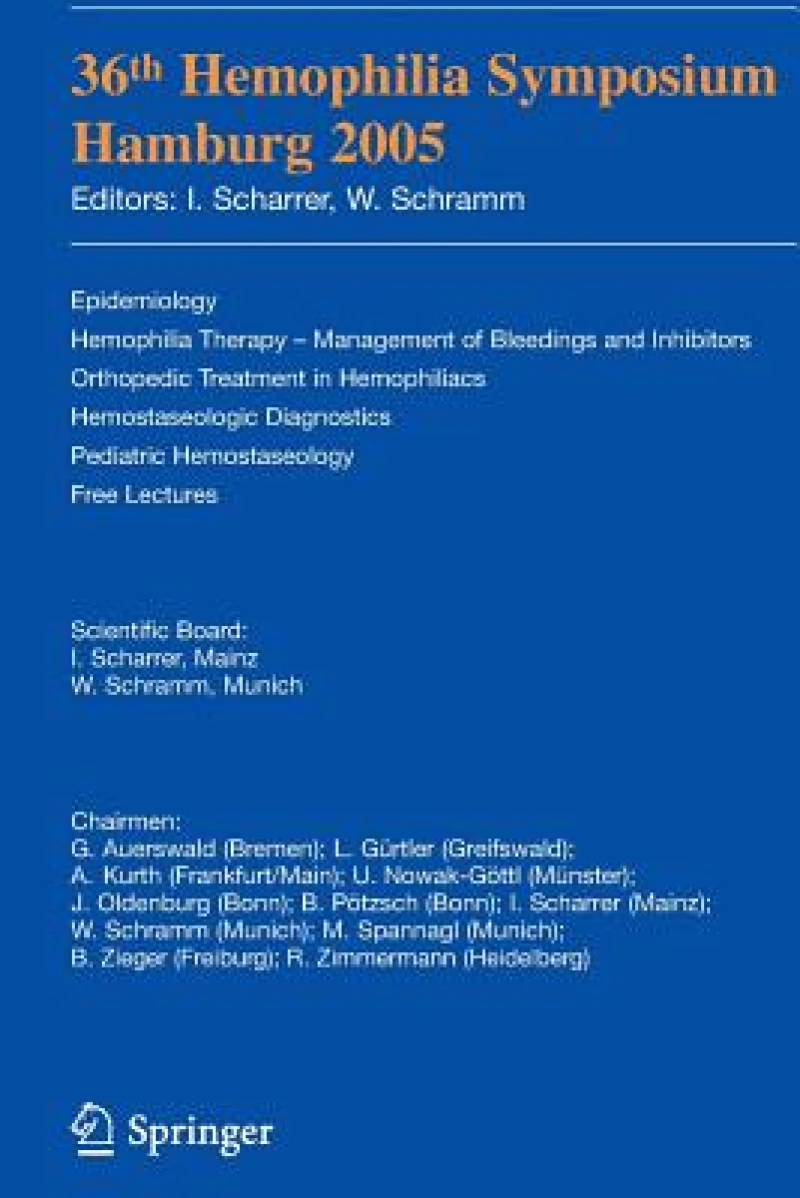
36th Hemophilia Symposium Hamburg 2005 : Epidemiology; Hemophilia Therapy - Management of Bleedings and Inhibitors; Orthopedic Treatment in Hemophiliacs; Hemostaseologic Diagnosis; Pediatric Hemostaseology; Free Lectures
2007 ed.
Book Details
Format
Paperback / Softback
ISBN-10
3540367144
ISBN-13
9783540367147
Edition
2007 ed.
Publisher
Springer-Verlag Berlin and Heidelberg GmbH & Co. KG
Imprint
Springer-Verlag Berlin and Heidelberg GmbH & Co. K
Country of Manufacture
DE
Country of Publication
GB
Publication Date
Nov 2nd, 2006
Print length
319 Pages
Product Classification:
Haematology
Ksh 23,400.00
Werezi Extended Catalogue
0 in stock
Delivery Location
Delivery fee: Select location
Secure
Quality
Fast
About 31% of the patients with a factor VIII replacement therapy develop a factor VIII inhibitor.From these are 23% low-responder (< 5BE) and 77% high-responder (> 5BE) [8].In the case of severe hemophilia B,about 10.5% of the patients develop inhibitory antibodies [9]. Anti-factor VIII-antibodies are also seen in 15-78% healthy people without hemophilia [7, 17, 19]. Lacroix-Desmazes et al. [10, 11] showed anti-idiotypic antibodies neutralizing the inhibitory activity of the an- factor VIII antibodies in healthy people. Well-known predisposing factors for inhibitor formation are genetic features of factor VIII,which include large deletions,nonsense mutations or intrachromosomal recombinations [5, 23].Also, ethnic groups other than Caucasians (e.g.Africans) have a higher risk of developing inhibitors.Other risk factors are presumably de- ved from the immune system. For instance, a reduction of the inhibitor was seen with lower CD4+ T helper cell counts in HIV positive hemophilic patients [3,4].The development of inhibitors is very likely to be a Th-2 mediated event where cyto- nes and their receptors,T-cell receptors and the Major Histocompatibility Complex may also play an important role. Theoretical Background The substituted factor is an unknown protein for patients with a severe he- philia. Fig. 1. The normal immunoresponse (according to BAENKLER [2]) Abbreviations: TCR - T cell-receptor; APC - antigen presenting cell 36 I.Wieland et al.
Get 36th Hemophilia Symposium Hamburg 2005 by at the best price and quality guaranteed only at Werezi Africa's largest book ecommerce store. The book was published by Springer-Verlag Berlin and Heidelberg GmbH & Co. KG and it has pages.

