
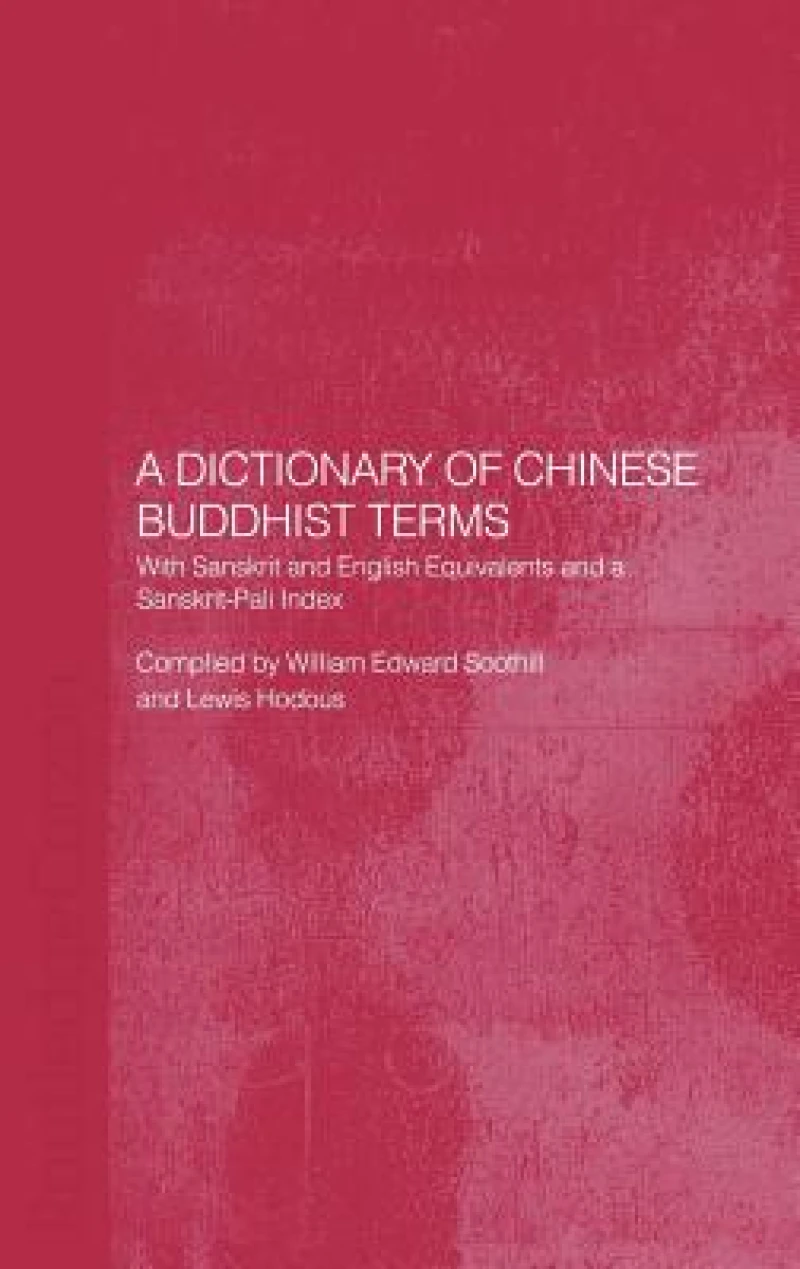
A Dictionary of Chinese Buddhist Terms : With Sanskrit and English Equivalents and a Sanskrit-Pali Index
Book Details
Format
Hardback or Cased Book
ISBN-10
0700703551
ISBN-13
9780700703555
Publisher
Taylor & Francis Ltd
Imprint
Routledge
Country of Manufacture
GB
Country of Publication
GB
Publication Date
Nov 23rd, 1995
Print length
536 Pages
Weight
974 grams
Dimensions
16.50 x 24.10 x 3.60 cms
Product Classification:
DictionariesBuddhism
Ksh 37,800.00
Werezi Extended Catalogue
0 in stock
Delivery Location
Delivery fee: Select location
Secure
Quality
Fast
This invaluable interpretive tool, first published in 1937, is now available for the first time in a paperback edition specially aimed at students of Chinese Buddhism.
This invaluable interpretive tool, first published in 1937, is now available for the first time in a paperback edition specially aimed at students of Chinese Buddhism.
Those who have endeavoured to read Chinese texts apart from the apprehension of a Sanskrit background have generally made a fallacious interpretation, for the Buddhist canon is basically translation, or analogous to translation. In consequence, a large number of terms existing are employed approximately to connote imported ideas, as the various Chinese translators understood those ideas. Various translators invented different terms; and, even when the same term was finally adopted, its connotation varied, sometimes widely, from the Chinese term of phrase as normally used by the Chinese.
For instance, klésa undoubtedly has a meaning in Sanskrit similar to that of, i.e. affliction, distress, trouble. In Buddhism affliction (or, as it may be understood from Chinese, the afflicters, distressers, troublers) means passions and illusions; and consequently fan-nao in Buddhist phraseology has acquired this technical connotation of the passions and illusions. Many terms of a similar character are noted in the body of this work. Consequent partly on this use of ordinary terms, even a well-educated Chinese without a knowledge of the technical equivalents finds himself unable to understand their implications.
Those who have endeavoured to read Chinese texts apart from the apprehension of a Sanskrit background have generally made a fallacious interpretation, for the Buddhist canon is basically translation, or analogous to translation. In consequence, a large number of terms existing are employed approximately to connote imported ideas, as the various Chinese translators understood those ideas. Various translators invented different terms; and, even when the same term was finally adopted, its connotation varied, sometimes widely, from the Chinese term of phrase as normally used by the Chinese.
For instance, klésa undoubtedly has a meaning in Sanskrit similar to that of, i.e. affliction, distress, trouble. In Buddhism affliction (or, as it may be understood from Chinese, the afflicters, distressers, troublers) means passions and illusions; and consequently fan-nao in Buddhist phraseology has acquired this technical connotation of the passions and illusions. Many terms of a similar character are noted in the body of this work. Consequent partly on this use of ordinary terms, even a well-educated Chinese without a knowledge of the technical equivalents finds himself unable to understand their implications.
Get A Dictionary of Chinese Buddhist Terms by at the best price and quality guaranteed only at Werezi Africa's largest book ecommerce store. The book was published by Taylor & Francis Ltd and it has pages.

