

A Guide to Gender and Classifiers
Book Details
Format
Hardback
ISBN-10
0198863608
ISBN-13
9780198863601
Publisher
Oxford University Press
Imprint
Oxford University Press
Country of Manufacture
GB
Country of Publication
GB
Publication Date
Mar 21st, 2025
Print length
496 Pages
Weight
870 grams
Dimensions
24.00 x 16.00 x 3.60 cms
KSh 24,550.00
Currently unavailable
0 in stock
Delivery Location
Delivery fee: Select location
Secure
Quality
Fast
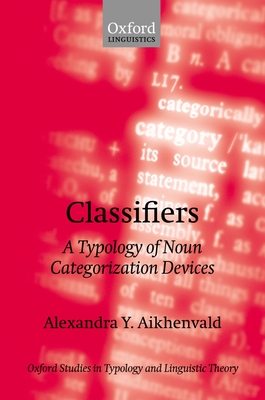
This book explores the range of noun categorization devices found in the languages of the world, from the numeral classifier systems of Southeast Asia to the highly grammaticalized gender agreement classes in Indo-European languages. It shows how these devices provide unique insights into how people categorize the world through the language.
This book explores the range of noun categorization devices found in the languages of the world, from the extensive systems of numeral classifiers in Southeast Asia to the highly grammaticalized gender agreement classes in Indo-European languages. Almost all languages use some type of noun categorization device in their grammar, with the most widespread being linguistic gender, whereby nouns are classified based on core semantic properties such as sex, animacy, humanness, or shape and size. Numeral classifiers are also common, and classify a noun in terms of its inherent nature, animacy, shape, and form, accompanied by a numeral or a quantifier. Other types of noun categorization devices include noun classifiers, possessive classifiers, verbal classifiers, and a number of rarer types such as locative and deictic classifiers. In this volume, Alexandra Aikhenvald investigates all facets of these nominal categorization systems, from their form and distribution to their origins, development, and loss. Noun categorization devices provide unique insights into how people categorize the world through the language: in one language, a human might be classified in terms of orientation, hence as ''vertical'', in another as male or female, and in another as simply ''animate'' or even ''rational''. They also change as society changes, reflecting the ways in which language and social environment are integrated into a single whole.
Get A Guide to Gender and Classifiers by Alexandra Y. Aikhenvald at the best price and quality guaranteed only at Werezi Africa's largest book ecommerce store. The book was published by Oxford University Press and it has 496 pages.
Customers Who Bought This Also Bought

Decolonising the Mind
KSh 4,700.00

Cultish
KSh 2,350.00

Digital Plurilingual Pedagogies in Teacher Education
KSh 27,900.00

Linguistic Landscape Studies of Global Chinese
KSh 30,800.00
Voice of Deliverance
KSh 6,450.00

Romania Africana
KSh 32,750.00

Second Language Learning and the COVID-19 Pandemic
KSh 21,250.00

Literacy Mediation
KSh 30,950.00

That''s Not What I Meant!
KSh 1,850.00

Construction Grammar and Sociolinguistic Theory
KSh 20,450.00

The Climate Turn in Language Teaching
KSh 3,250.00
The Cambridge Handbook of Sociolinguistics
KSh 30,100.00
More by Alexandra Y. Aikhenvald

A Grammar of Tariana, from Northwest Amazonia
KSh 28,450.00

Imperatives and Commands
KSh 12,950.00

How Gender Shapes the World
KSh 7,300.00

A Grammar of Tariana, from Northwest Amazonia
KSh 10,150.00
How Gender Shapes the World
KSh 23,100.00
Evidentiality
KSh 39,850.00

The Languages of the Amazon
KSh 33,700.00

The Art of Grammar
KSh 29,800.00

The Languages of the Amazon
KSh 13,700.00
Classifiers
KSh 14,450.00
Serial Verbs
KSh 7,600.00

Classifiers
KSh 60,900.00
