
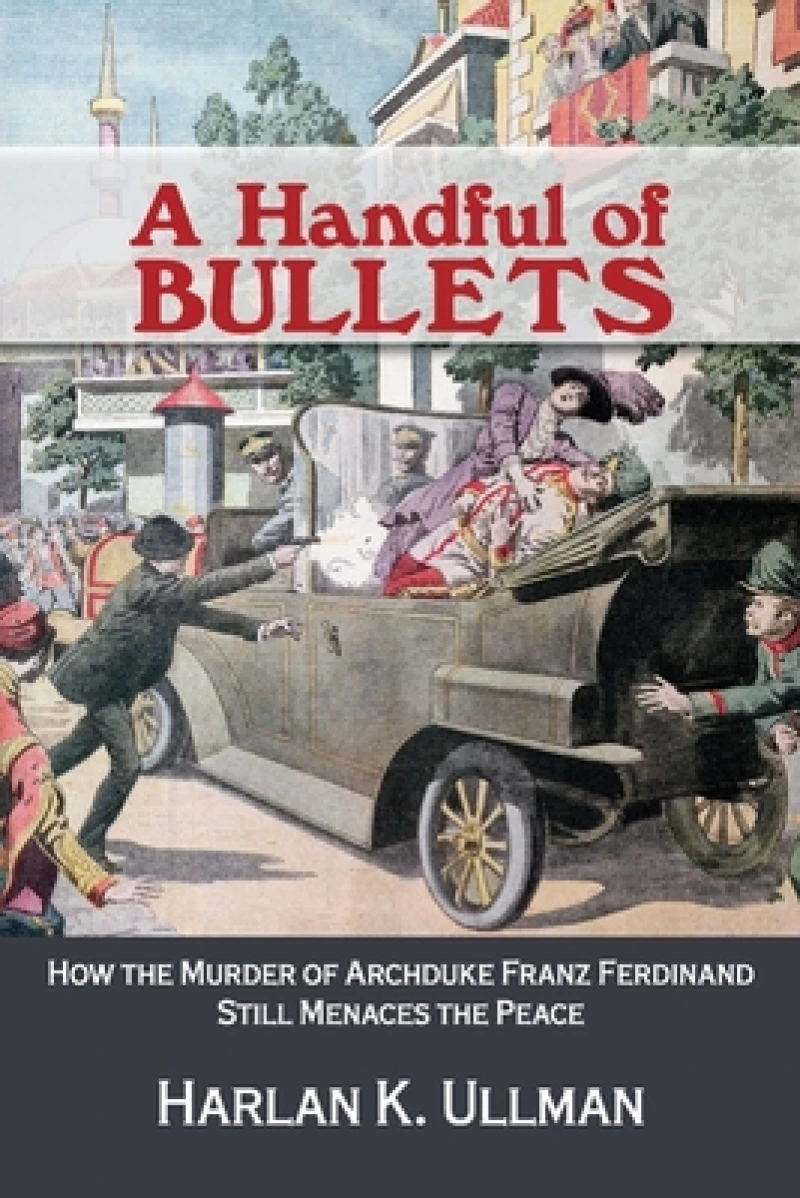
A Handful of Bullets : How the Murder of Archduke Franz Ferdinand Still Menaces the Peace
Book Details
Format
Paperback / Softback
ISBN-10
1682476545
ISBN-13
9781682476543
Publisher
Naval Institute Press
Imprint
Naval Institute Press
Country of Manufacture
GB
Country of Publication
GB
Publication Date
Jul 8th, 2021
Print length
256 Pages
Weight
907 grams
Product Classification:
Military historyInternational relationsWarfare & defenceDefence strategy, planning & research
Ksh 4,600.00
Werezi Extended Catalogue
0 in stock
Delivery Location
Delivery fee: Select location
Secure
Quality
Fast
The Great War or the "War to end all wars" as promised by President Woodrow Wilson was neither great nor ultimately conclusive. Precipitated by the assassination of the Austro—Hungarian Archduke Franz Ferdinand and his wife in the streets of Sarajevo on June 28, 1914, World War I demolished the order established by the Concert of Vienna, an order that had maintained the peace in Europe for almost a century. The ensuing carnage laid the foundation for World War II and the Cold War that followed. World War I also left in its catastrophic wake three transformational legacies that remain largely unnoticed today. These legacies have provoked and will continue to provoke massive change to the international order. But containing, mitigating, and preventing these disruptions from exploding into major crises will prove no less difficult a challenge than did restraining the forces that ignited the chaos and violence of the last century. These legacies would make Osama bin Laden into a modern day version of Gavrilo Princip, the Archduke's assassin, and turn September 11, 2001 into an event like that one on June 28, 1914, in many different and frightening ways. Instead of using a Beretta 9 mm pistol, bin Laden crashed three airliners into New York's Twin Towers and the Pentagon in Washington, D.C., starting a global war on terror. Unfortunately, America's current strategic mindset to deal with the twenty-first century remains firmly anchored in the previous century. That mindset must change if aspirations for peace and prosperity are to be met with decisive and effective actions. Ullman offers provocative and challenging arguments to conventional wisdom—that we fail to understand the challenges and dangers and lack a mindset to cope with these twenty-first-century realities. He argues that while the dangers are not as destructive as a world war, unless they are addressed, at best the standard of living and expectations of Americans will decline, and at worst, the world will become more violent, unpredictable, and chaotic.
The Great War or the “War to end all wars” as promised by President Woodrow Wilson was neither great nor ultimately conclusive. Precipitated by the assassination of the Austro-Hungarian Archduke Franz Ferdinand and his wife in the streets of Sarajevo on June 28, 1914, World War I demolished the order established by the Concert of Vienna, an order that had maintained the peace in Europe for almost a century. The ensuing carnage laid the foundation for World War II and the Cold War that followed. World War I also left in its catastrophic wake three transformational legacies that remain largely unnoticed today. These legacies have provoked and will continue to provoke massive change to the international order. But containing, mitigating, and preventing these disruptions from exploding into major crises will prove no less difficult a challenge than did restraining the forces that ignited the chaos and violence of the last century. These legacies would make Osama bin Laden into a modern day version of Gavrilo Princip, the Archduke''s assassin, and turn September 11, 2001 into an event like that one on June 28, 1914, in many different and frightening ways. Instead of using a Beretta 9 mm pistol, bin Laden crashed three airliners into New York''s Twin Towers and the Pentagon in Washington, D.C., starting a global war on terror. Unfortunately, America''s current strategic mindset to deal with the twenty-first century remains firmly anchored in the previous century. That mindset must change if aspirations for peace and prosperity are to be met with decisive and effective actions. Ullman offers provocative and challenging arguments to conventional wisdom-that we fail to understand the challenges and dangers and lack a mindset to cope with these twenty-first-century realities. He argues that while the dangers are not as destructive as a world war, unless they are addressed, at best the standard of living and expectations of Americans will decline, and at worst, the world will become more violent, unpredictable, and chaotic.
Get A Handful of Bullets by at the best price and quality guaranteed only at Werezi Africa's largest book ecommerce store. The book was published by Naval Institute Press and it has pages.

