
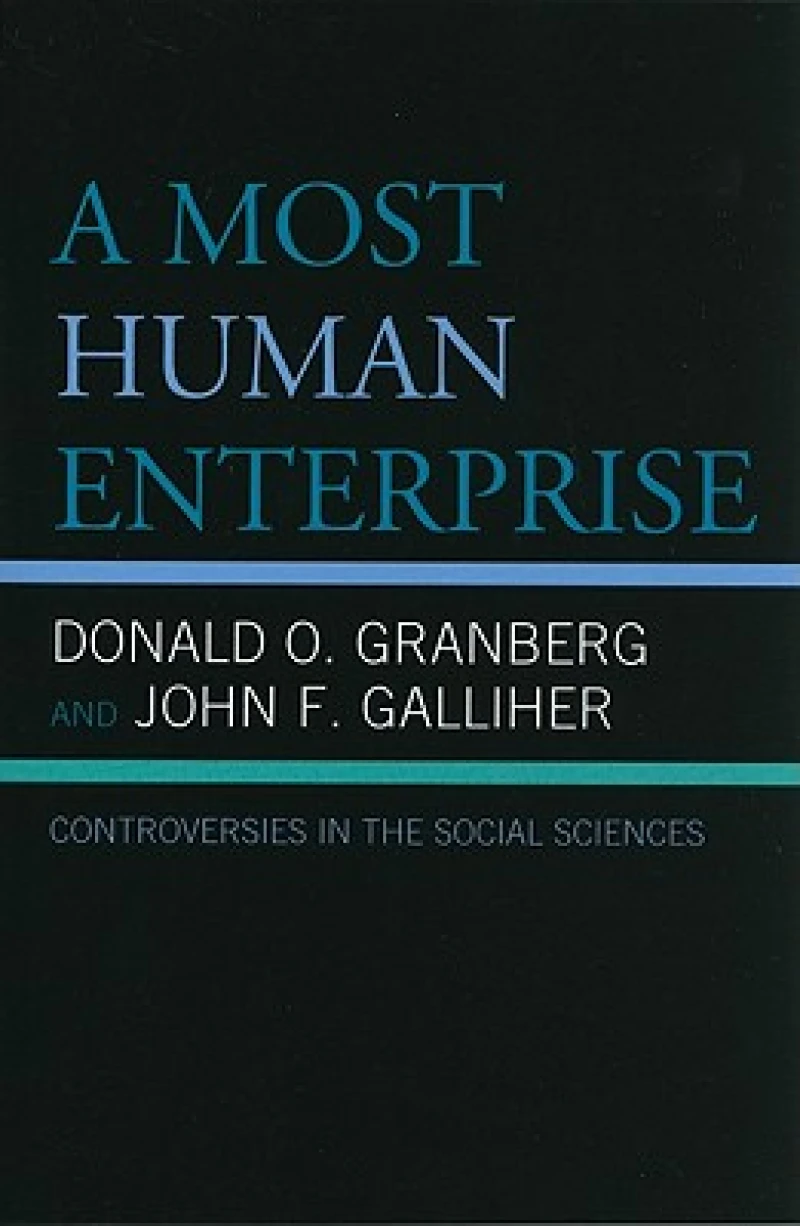
A Most Human Enterprise : Controversies in the Social Sciences
Book Details
Format
Paperback / Softback
ISBN-10
0739127977
ISBN-13
9780739127971
Publisher
Bloomsbury Publishing Plc
Imprint
Lexington Books
Country of Manufacture
GB
Country of Publication
GB
Publication Date
Mar 18th, 2010
Print length
162 Pages
Weight
256 grams
Dimensions
15.40 x 22.80 x 1.00 cms
Product Classification:
Social research & statistics
Ksh 9,700.00
Manufactured on Demand
0 in stock
Delivery Location
Delivery fee: Select location
Secure
Quality
Fast
A Most Human Enterprise looks at controversial social science research methods and their effects on subjects and researchers. In detailing case studies in which plagiarism was alleged, subjects were mislead or seriously abused, and research denigrated certain demographics, Donald O. Granberg and John F. Galliher demonstrate how social scientists have strayed from the ethical standards of scientific research. Case studies include the infamous Tuskegee Syphilis Study, the well-known pseudo-prison work of Philip Zimbardo, the obedience research of Stanley Milgram, and the study of sex in public places by sociologist Laud Humphreys. Many of the studies that were most damaging to human subjects were funded by government, making the current concerns of university Institutional Review Boards seem ironic. A Most Human Enterprise also investigates consequences of plagiarism in the social sciences, the role that whistle blowers can play, and the consequences of their acts. Humans are, of course, capable of lofty and amazing accomplishments. Yet they are, nevertheless, also subject to bias, prejudice, ego involvement, and poor judgment. This book demonstrates the inadequacy of Institutional Review Boards in limiting ethical lapses in the social sciences, and seeks to create a reader more sensitive to the problems and pitfalls that arise in the course of doing social research.
A Most Human Enterprise looks at controversial social science research methods and their effects on subjects and researchers. In detailing case studies in which plagiarism was alleged, subjects were mislead or seriously abused, and research denigrated certain demographics, Donald O. Granberg and John F. Galliher demonstrate how social scientists have strayed from the ethical standards of scientific research. Case studies include the infamous Tuskegee Syphilis Study, the well-known pseudo-prison work of Philip Zimbardo, the obedience research of Stanley Milgram, and the study of sex in public places by sociologist Laud Humphreys. Many of the studies that were most damaging to human subjects were funded by government, making the current concerns of university Institutional Review Boards seem ironic. A Most Human Enterprise also investigates consequences of plagiarism in the social sciences, the role that whistle blowers can play, and the consequences of their acts. Humans are, of course, capable of lofty and amazing accomplishments. Yet they are, nevertheless, also subject to bias, prejudice, ego involvement, and poor judgment. This book demonstrates the inadequacy of Institutional Review Boards in limiting ethical lapses in the social sciences, and seeks to create a reader more sensitive to the problems and pitfalls that arise in the course of doing social research.
Get A Most Human Enterprise by at the best price and quality guaranteed only at Werezi Africa's largest book ecommerce store. The book was published by Bloomsbury Publishing Plc and it has pages.

