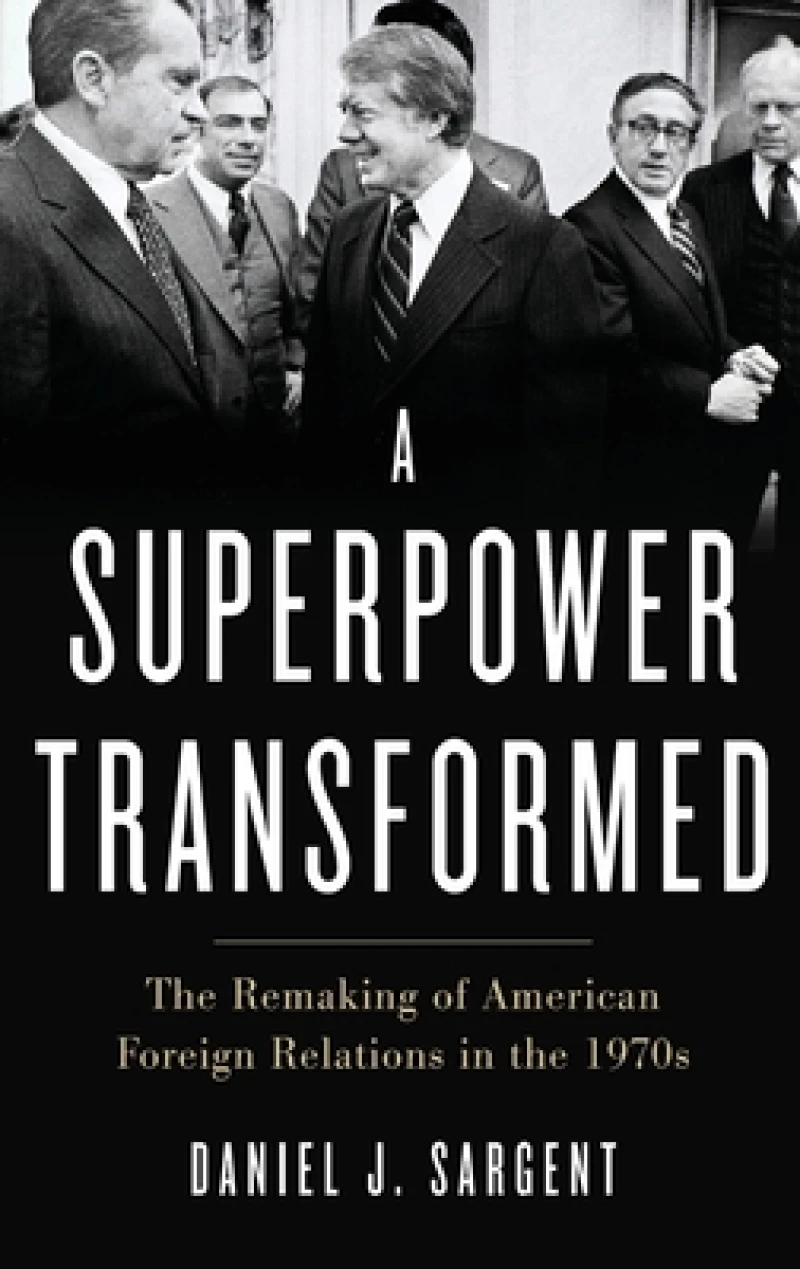
A Superpower Transformed : The Remaking of American Foreign Relations in the 1970s
Book Details
Format
Hardback or Cased Book
ISBN-10
0195395476
ISBN-13
9780195395471
Publisher
Oxford University Press Inc
Imprint
Oxford University Press Inc
Country of Manufacture
US
Country of Publication
GB
Publication Date
Jan 8th, 2015
Print length
452 Pages
Weight
718 grams
Dimensions
23.90 x 16.40 x 3.60 cms
Ksh 8,100.00
Manufactured on Demand
0 in stock
Delivery Location
Delivery fee: Select location
Secure
Quality
Fast
Geopolitics and globalization collided in the 1970s, and their collision produced difficult challenges for the makers of American foreign policy. A Superpower Transformed explains how policymakers across three administrations worked to manage complex international changes in a tumultuous era, and it explores the legacies of their efforts to accommodate American power to new forces stirring in world affairs.
A Superpower Transformed explores the predicament of American foreign policy in the 1970s. This was a phase when the dilemmas of an emerging post-Cold War era buffeted the United States even as the makers of American foreign policy struggled for stability in an enduring Cold War. Clashing imperatives made the 1970s a difficult phase. Amidst conflicting pressures, leaders struggled to devise strategic frameworks to guide the exercise of American power in the world. 1970s-era choices nonetheless proved consequential. The Nixon administration''s efforts to stabilize a faltering Pax Americana faltered, but Nixon''s choices ultimately helped the champions of human rights to wrest control of American foreign policy away from the practitioners of amoral realpolitik. So too did Nixon''s efforts to reverse the decline of American economic power help to open the doors to financial globalization, which accelerated quickly in the years following the 1971-73 collapse of the Bretton Woods international monetary system.Choices proved consequential, but American decision makers remained the captives of unmasterable circumstances, as the oil crisis of 1973-74 made clear. Coinciding with Watergate, the oil crisis plunged the world economy into disarray. It also pushed American decision makers to begin to devise new strategies to manage-or mitigate-the consequences of economic globalization. Henry Kissinger, who led this effort, was less successful in his attempts to terms with a human rights movement that flourished in the mid-1970s. Not until the inauguration of the Carter administration would American decision makers embrace human rights promotion as a central task for foreign policy. Carter''s efforts to devise a post-Cold War foreign policy nonetheless faltered, confounded in the last years of 1970s by the resurgence of Soviet-American hostilities. While the Cold War resurged, the new forces of globalization and human rights that mobilized in the 1970s left the United States a superpower transformed.
Get A Superpower Transformed by at the best price and quality guaranteed only at Werezi Africa's largest book ecommerce store. The book was published by Oxford University Press Inc and it has pages.