
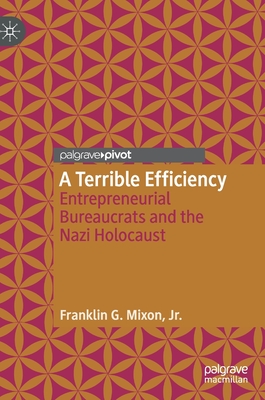
A Terrible Efficiency : Entrepreneurial Bureaucrats and the Nazi Holocaust
2019 ed.
Book Details
Format
Hardback
ISBN-10
3030257665
ISBN-13
9783030257668
Edition
2019 ed.
Publisher
Springer Nature Switzerland AG
Imprint
Springer Nature Switzerland AG
Country of Manufacture
CH
Country of Publication
GB
Publication Date
Sep 9th, 2019
Print length
153 Pages
Product Classification:
Second World WarWelfare economicsWelfare economicsEconomic historySecond World War
KSh 8,100.00
Currently unavailable
0 in stock
Delivery Location
Delivery fee: Select location
Secure
Quality
Fast
This book provides numerous examples that apply the modern theory of bureaucracy developed in Breton and Wintrobe (1982 and 1986) to the Nazi Holocaust.
This book provides numerous examples that apply the modern theory of bureaucracy developed in Breton and Wintrobe (1982 and 1986) to the Nazi Holocaust. More specifically, the book argues, as do Breton and Wintrobe (1986), that the subordinates in the Nazi bureaucracy were not "following orders" as they claimed during the war crimes trials at Nuremberg and elsewhere, but were instead exhibiting an entrepreneurial spirit in competing with one another in order to find the most efficient way of exacting the Final Solution. This involved engaging in a process of exchange with their superiors, wherein the subordinates offered the kinds of informal services that are not codified in formal contracts. In doing so, they were competing for the rewards, or informal payments not codified in formal contracts, that were conferred by those at the top of the bureaucracy. These came in the form of rapid promotion, perquisites (pecuniary and in-kind), and other awards. The types of exchanges described above are based on "trust," not formal institutions.
Get A Terrible Efficiency by Franklin G. Mixon Jr. at the best price and quality guaranteed only at Werezi Africa's largest book ecommerce store. The book was published by Springer Nature Switzerland AG and it has 153 pages.
Customers Who Bought This Also Bought

Churchill
KSh 3,700.00
Bomber Mafia
KSh 2,350.00
American Prometheus
KSh 2,700.00

Man''s Search For Meaning
KSh 1,600.00

India After Gandhi
KSh 4,850.00

Hiroshima
KSh 2,000.00

Holocaust
KSh 2,700.00

East West Street
KSh 2,350.00

Path of Light
KSh 2,350.00

Come to This Court and Cry
KSh 2,000.00

Hiroshima Men
KSh 4,500.00

Unbroken
KSh 2,350.00
