
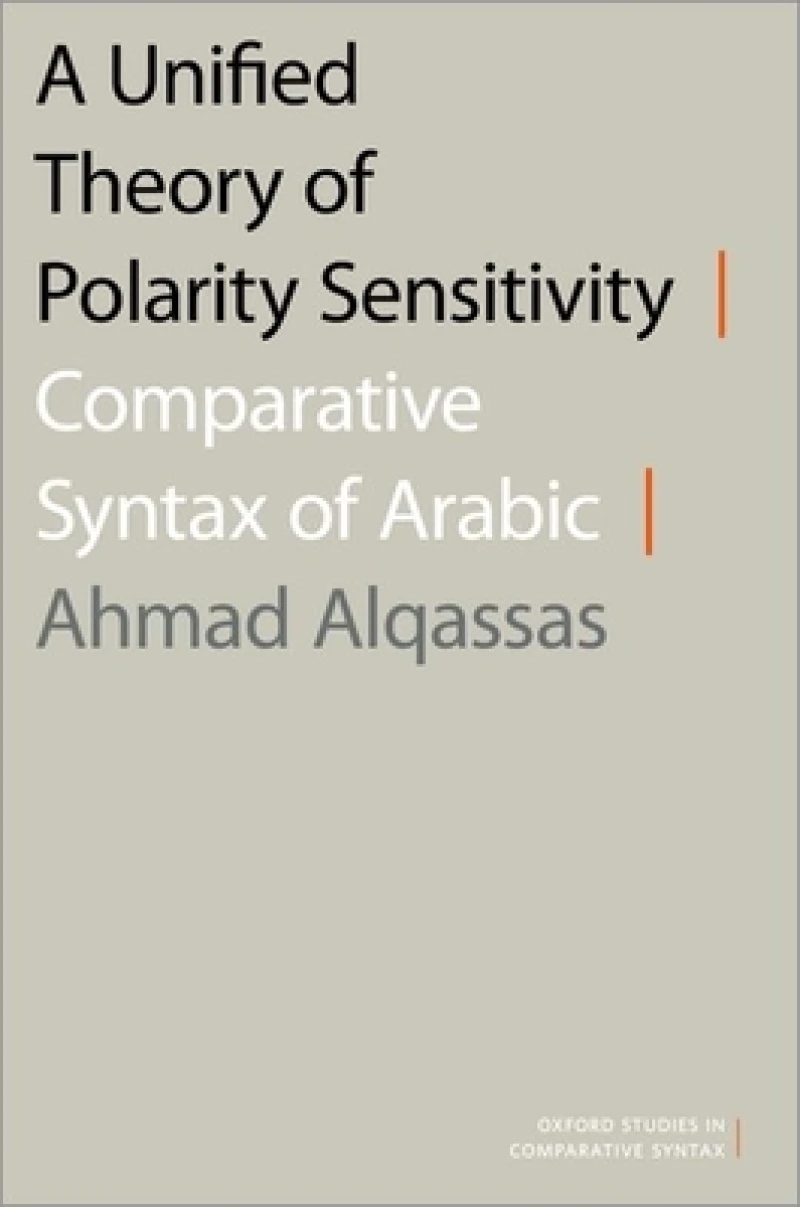
A Unified Theory of Polarity Sensitivity : Comparative Syntax of Arabic
Book Details
Format
Hardback or Cased Book
Book Series
Oxford Studies in Comparative Syntax
ISBN-10
0197554881
ISBN-13
9780197554883
Publisher
Oxford University Press Inc
Imprint
Oxford University Press Inc
Country of Manufacture
US
Country of Publication
GB
Publication Date
Sep 30th, 2021
Print length
258 Pages
Weight
499 grams
Dimensions
16.00 x 24.30 x 2.10 cms
Ksh 19,400.00
Manufactured on Demand
0 in stock
Delivery Location
Delivery fee: Select location
Secure
Quality
Fast
This book examines polarity sensitivity - a ubiquitous phenomenon involving expressions such as anybody, nobody, ever, never, somebody and their counterparts in other languages. In this book, Ahmad Alqassas proposes a unified approach by examining the interaction between the various types of polarity sensitivity. Drawing on data from Standard Arabic and the major regional dialects represented by Jordanian, Egyptian, Moroccan, and Qatari, the book provides a new perspective on the syntax-semantic interface and develops a unified syntactic analysis for polarity sensitivity.
Polarity sensitivity is a ubiquitous phenomenon involving expressions such as anybody, nobody, ever, never, somebody and their counterparts in other languages. These expressions belong to different classes such as negative and positive polarity, negative concord, and negative indefinites. In this book, Ahmad Alqassas proposes a unified approach to the study of this phenomenon that relies on examining the interaction between the various types of polarity sensitivity, with a particular focus on Arabic. Alqassas shows that treating this interaction is fundamental for scrutinizing their licensing conditions. Alqassas draws on data from Standard Arabic and the major regional dialects represented by Jordanian, Egyptian, Moroccan, and Qatari. Through the (micro)comparative approach, Alqassas explains the distributional contrasts with a minimal set of universal syntactic operations such as Merge, Move, and Agree. He also considers a fine-grained inventory of negative formal features for polarity items and their licensors. These simple features paint a complex landscape of polarity and lead to important conclusions about syntactic computation. By engaging with the rich but under-studied landscape of Arabic polarity sensitivity, this book provides a new perspective on the syntax-semantic interface and develops a unified syntactic analysis for polarity sensitivity. These contributions have important implications for the study of Arabic and for syntactic theory more generally.
Get A Unified Theory of Polarity Sensitivity by at the best price and quality guaranteed only at Werezi Africa's largest book ecommerce store. The book was published by Oxford University Press Inc and it has pages.

