
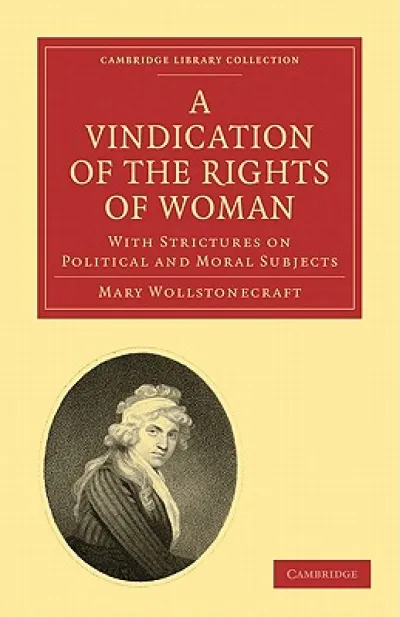
A Vindication of the Rights of Woman : With Strictures on Political and Moral Subjects
Book Details
Format
Paperback / Softback
ISBN-10
1108018858
ISBN-13
9781108018852
Publisher
Cambridge University Press
Imprint
Cambridge University Press
Country of Manufacture
GB
Country of Publication
GB
Publication Date
Oct 28th, 2010
Print length
478 Pages
Weight
600 grams
Dimensions
21.60 x 14.00 x 2.70 cms
Product Classification:
Feminism and feminist theoryFeminism & feminist theoryHuman rightsHuman rights, civil rights
Ksh 8,450.00
Manufactured on Demand
0 in stock
Delivery Location
Delivery fee: Select location
Secure
Quality
Fast
In this passionate reaction to Rousseau's pedagogical work Emile (1762) Wollstonecraft powerfully defends woman's ability to reason, given appropriate education. Her radical prescription was for girls to be educated alongside boys and to the same standard. Originally published in 1792, this is a foundational work of feminist political thought.
Mary Wollstonecraft (1759–1797) published A Vindication of the Rights of Woman in 1792. It was written in reaction to Rousseau's Emile (1762), which argued that the purpose of a girl's education was to make her useful to a man. Wollstonecraft offered a defence of woman's ability to reason, given appropriate education. She argued that the limited education given to women made them docile and empty-headed playthings whose supposed fragility and coquetry were constructions that damaged not only the individual but society as a whole. Her radical prescription was for girls to be educated alongside boys and to the same standard, so that they were not left dependent on marriage for financial security. The independence of mind displayed in this polemic has ensured its place as a foundational work in the canon of feminist thought. For more information on this author, see http://orlando.cambridge.org/public/svPeople?person_id=wollma
Get A Vindication of the Rights of Woman by at the best price and quality guaranteed only at Werezi Africa's largest book ecommerce store. The book was published by Cambridge University Press and it has pages.

