
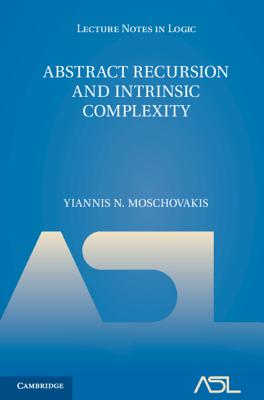
Abstract Recursion and Intrinsic Complexity
Book Details
Format
Hardback
Book Series
Lecture Notes in Logic
ISBN-10
110841558X
ISBN-13
9781108415583
Publisher
Cambridge University Press
Imprint
Cambridge University Press
Country of Manufacture
GB
Country of Publication
GB
Publication Date
Dec 6th, 2018
Print length
250 Pages
Weight
470 grams
Dimensions
23.50 x 15.70 x 1.80 cms
Product Classification:
Mathematical logic
KSh 21,800.00
Currently unavailable
0 in stock
Delivery Location
Delivery fee: Select location
Secure
Quality
Fast
The author presents and applies a new framework for studying the complexity of algorithms. The book is aimed at logicians, computer scientists, mathematicians and philosophers who are interested in the theory of computation and its foundations. It includes an accessible introduction to abstract recursion theory and contains over 250 problems.
This book presents and applies a framework for studying the complexity of algorithms. It is aimed at logicians, computer scientists, mathematicians and philosophers interested in the theory of computation and its foundations, and it is written at a level suitable for non-specialists. Part I provides an accessible introduction to abstract recursion theory and its connection with computability and complexity. This part is suitable for use as a textbook for an advanced undergraduate or graduate course: all the necessary elementary facts from logic, recursion theory, arithmetic and algebra are included. Part II develops and applies an extension of the homomorphism method due jointly to the author and Lou van den Dries for deriving lower complexity bounds for problems in number theory and algebra which (provably or plausibly) restrict all elementary algorithms from specified primitives. The book includes over 250 problems, from simple checks of the reader''s understanding, to current open problems.
Get Abstract Recursion and Intrinsic Complexity by Yiannis N. Moschovakis at the best price and quality guaranteed only at Werezi Africa's largest book ecommerce store. The book was published by Cambridge University Press and it has 250 pages.
Customers Who Bought This Also Bought
Elements of 8-Category Theory
KSh 13,300.00

Fuzzy Set Theory—and Its Applications
KSh 47,350.00
Lectures in Logic and Set Theory
KSh 9,550.00

Complex Dynamical Systems
KSh 19,250.00
Distributed Networks
KSh 16,400.00
Suguru Puzzle Book
KSh 0.00

The Baseball Mysteries
KSh 5,450.00

Information Security and Optimization
KSh 22,500.00

Problem Solving In Operation Management
KSh 14,400.00

Belief Change
KSh 32,400.00

Neutrosophic Computing and Vague Data Analysis
KSh 22,500.00

Introduction to Modern Cryptography, Revised Third Edition
KSh 9,350.00
