
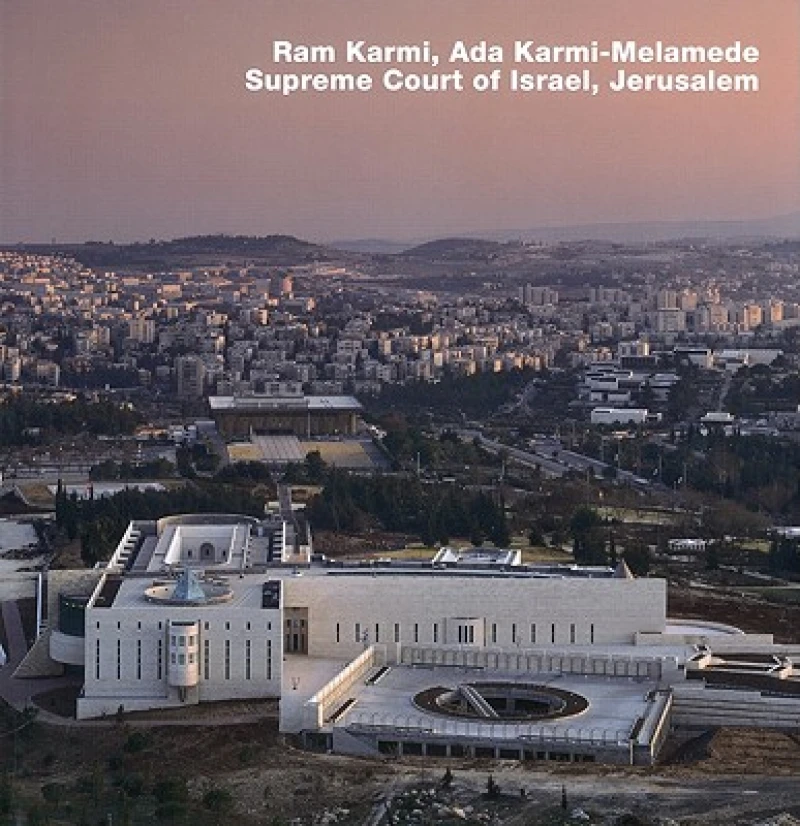
Ada Karmi-Melamede and Ram Karmi, Supreme Court of Israel, Jerusalem : Opus 71
Book Details
Format
Hardback or Cased Book
ISBN-10
3932565711
ISBN-13
9783932565717
Publisher
Edition Axel Menges
Imprint
Edition Axel Menges
Country of Manufacture
DE
Country of Publication
GB
Publication Date
Jul 1st, 2010
Print length
60 Pages
Weight
804 grams
Dimensions
31.00 x 29.00 x 1.10 cms
Product Classification:
Public buildings: civic, commercial, industrial, etc
Ksh 5,200.00
Temporarily out of stock, due soon
0 in stock
Delivery Location
Delivery fee: Select location
Secure
Quality
Fast
While referred to as a single building, in reality the Supreme Court building is an ensemble applying urban principles to the interior, thus producing public spaces throughout. Half architecture, half landscape architecture, the Supreme Court building is deeply anchored in its site and reaches out further than its own walls.
Intent on realising her late husband''s vision, Dorothy de Rothschild first offered to provide funding for a new building housing the Supreme Court of Israel in the 1960s. In 1983 the offer was seriously considered and accepted. Renowned architects from Israel and from all over the world entered into a two-stage competition in 1986. Ada Karmi-Melamede and Ram Karmi, siblings their own architecture practices, were asked to compete as a team. Their contribution stood out clearly against the other entries. Instead of proposing a formal and monumental scheme, the Karmis came up with a coherent site-specific building which roots itself into the land, continues the stone language of Jerusalem, and relates to its unique vibrant light. Pure geometrical volumes are arranged to form a balanced composition and complex whole. A careful equilibrium is created between the gravity of local stone-masonry walls and the immaterial play of light and shadow in the voids and volumes of the structure. The Supreme Court acts as part of a larger civic urban ensemble and forms a gateway to Government Hill offering a pedestrian walkway to the Knesset. While referred to as a single building, in reality the Supreme Court building is an ensemble applying urban principles to the interior, thus producing public spaces throughout. Half architecture, half landscape architecture, the building is deeply anchored in its site and reaches out further than its own walls. Four main functions are manifested in four distinct geometric volumes organised by two cardinal axes. These axes separate the four main program elements: the library, the judges'' chambers, the courtrooms and the parking area. The allocation of the various volumes within the building allows for a sequence of in-between spaces which are used for circulation, for the penetration of natural light and for the transition between the public and private domains. Paul Goldberger stated in The New York Times in 1995 that "the sharpness of the Mediterranean architectural tradition and the dignity of law are here married with remarkable grace.
Get Ada Karmi-Melamede and Ram Karmi, Supreme Court of Israel, Jerusalem by at the best price and quality guaranteed only at Werezi Africa's largest book ecommerce store. The book was published by Edition Axel Menges and it has pages.

