
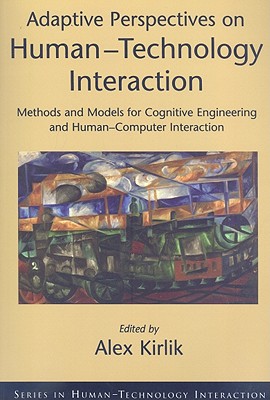
Adaptive Perspectives on Human-Technology Interaction : Methods and Models for Cognitive Engineering and Human-Computer Interaction
by
Alex Kirlik
Book Details
Format
Paperback / softback
Book Series
Human Technology Interaction Series
ISBN-10
0195374827
ISBN-13
9780195374827
Publisher
Oxford University Press Inc
Imprint
Oxford University Press Inc
Country of Manufacture
US
Country of Publication
GB
Publication Date
Nov 4th, 2010
Print length
336 Pages
Weight
556 grams
Dimensions
17.30 x 25.10 x 1.50 cms
KSh 11,050.00
Currently unavailable
0 in stock
Delivery Location
Delivery fee: Select location
Secure
Quality
Fast
In everyday life, and particularly in the modern workplace, information technology and automation increasingly mediate, augment, and sometimes even interfere with how humans interact with their environment. How to understand and support cognition in human-technology interaction is both a practically and socially relevant problem. The chapters in this volume frame this problem in adaptive terms: How are behavior and cognition adapted, or perhaps ill-adapted, to the demands and opportunities of an environment where interaction is mediated by tools and technology? The authors draw heavily on the work of Egon Brunswik, a pioneer in ecological and cognitive psychology, as well as on modern refinements and extensions of Brunswikian ideas, including Hammond''s Social Judgment Theory, Gigerenzer''s Ecological Rationality and Anderson''s Rational Analysis. Inspired by Brunswik''s view of cognition as "coming to terms" with the "casual texture" of the external world, the chapters in this volume provide quantitative and computational models and measures for studying how people come to terms with an increasingly technological ecology, and provide insights for supporting cognition and performance through design, training, and other interventions. The methods, models, and measures presented in this book provide timely and important resources for addressing problems in the rapidly growing field of human-technology interaction. The book will be of interest to researchers, students, and practitioners in human factors, cognitive engineering, human-computer interaction, judgment and decision making, and cognitive science.Please visit this website for additional materials:http://www.humanfactors.illinois.edu/resources/OtherResourses/LensModel.asp x
Get Adaptive Perspectives on Human-Technology Interaction by Alex Kirlik at the best price and quality guaranteed only at Werezi Africa's largest book ecommerce store. The book was published by Oxford University Press Inc and it has 336 pages.
Customers Who Bought This Also Bought

Replaceable You
KSh 3,400.00

Paediatric Handbook, 10th Edition
KSh 7,550.00

Biofabrication in Regenerative Medicine
KSh 32,400.00

Cell Therapy Against Cerebral Stroke
KSh 21,600.00

Smart Nanomaterials in Biomedical Applications
KSh 21,600.00

Tissue-Specific Stem Cell Niche
KSh 23,400.00

Sustainable Nanocomposites With Green Biomaterials
KSh 27,000.00

Integrated Nanomaterials and Their Applications
KSh 25,200.00

Skin Tissue Engineering
KSh 39,600.00

Clinical Applications of Advanced Ultrasound Technologies
KSh 16,200.00

Medical Metaverse for Digital Healthcare
KSh 29,900.00

Pancreatic Islet Biology
KSh 23,400.00
