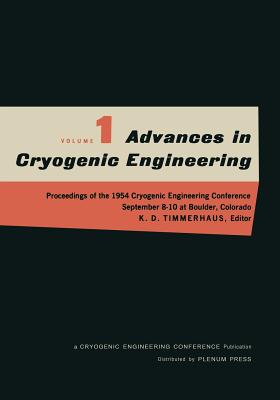
Advances in Cryogenic Engineering : Proceedings of the 1954 Cryogenic Engineering Conference National Bureau of Standards Boulder, Colorado September 8–10 1954
Softcover reprint of the original 1st ed. 1960
Book Details
Format
Paperback / softback
Book Series
Advances in Cryogenic Engineering
ISBN-10
1468431013
ISBN-13
9781468431018
Edition
Softcover reprint of the original 1st ed. 1960
Publisher
Springer-Verlag New York Inc.
Imprint
Springer-Verlag New York Inc.
Country of Manufacture
US
Country of Publication
GB
Publication Date
Mar 8th, 2012
Print length
364 Pages
Product Classification:
Interdisciplinary studies
KSh 16,200.00
Currently unavailable
0 in stock
Delivery Location
Delivery fee: Select location
Secure
Quality
Fast
Cryogenic engineering is concerned with developing and improving low temperature processes, techniques, and equipment; It is rather difficult to assign a definite temperature which serves to divide refrigerating engineering from cryogenic engineering.
More than sixty years have elapsed since Linde first liquefied air on a commercial scale and prepared the way for separating of other gaseous mixtures. His work, however, was not of an isolated nature. It was conceived eighteen years after air had, for the first time, been liquefied in the laboratory by Pictet in Geneva and Caillete in Paris. Linde''s liquefaction of air was followed by Dewar''s work on hydrogen liquefaction in London and by the setting up at Leiden of Kamerlingh Onnes''s famous low temperature laboratory. These advances in low temperature or cryogenic technology have resulted in the establishment of a completely new and thriving industry. Cryogenic engineering is concerned with developing and improving low temperature processes, techniques, and equipment; determining the physical properties of structural and related materials used in producing, maintaining, and using low temperatures; and the practical application of low temperature techniques and processes. These low tempera tures are below those usually encountered in refrigerating engineering. It is rather difficult to assign a definite temperature which serves to divide refrigerating engineering from cryogenic engineering. A temperature below _lSOoC, however, is generally associated with cryogenic engineering.
Get Advances in Cryogenic Engineering by K. D. Timmerhaus at the best price and quality guaranteed only at Werezi Africa's largest book ecommerce store. The book was published by Springer-Verlag New York Inc. and it has 364 pages.
Customers Who Bought This Also Bought

Night Rules
KSh 30,950.00

Inclusive Participation in Planning in the UK
KSh 30,950.00

Reinventing the River City
KSh 17,500.00

Inclusive Participation in Planning in the UK
KSh 7,900.00

Night Rules
KSh 7,200.00

Reinventing the River City
KSh 4,150.00

Ideology and Cinematography in Hollywood, 1930-39
KSh 23,400.00

Public Spaces and the Politics of Citizen Participation
KSh 7,900.00

Laws of Nature
KSh 23,400.00

Planning and Design for Sustainable Urban Mobility
KSh 11,450.00

La recherche interdisciplinaire sous la loupe
KSh 7,550.00

2000 Lectures and Memoirs
KSh 16,700.00