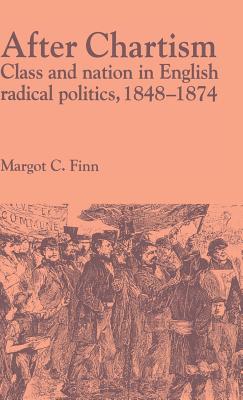
After Chartism : Class and Nation in English Radical Politics 1848–1874
by
Margot Finn
Book Details
Format
Paperback / softback
Book Series
Past and Present Publications
ISBN-10
0521525985
ISBN-13
9780521525985
Publisher
Cambridge University Press
Imprint
Cambridge University Press
Country of Manufacture
GB
Country of Publication
GB
Publication Date
Jan 22nd, 2004
Print length
376 Pages
Weight
544 grams
Dimensions
21.60 x 14.20 x 2.30 cms
KSh 5,600.00
Currently unavailable
0 in stock
Delivery Location
Delivery fee: Select location
Secure
Quality
Fast
This book charts the course of working- and middle-class radical politics in England from the fall of Chartism in 1848 to the fall of Gladstone's Liberal government in 1874. The author argues that these years saw the gradual radicalisation of middle-class liberals, rather than the demoralisation of working-class culture.
This book charts the course of working- and middle-class radical politics in England from the continental revolutions of 1848 to the fall of Gladstone's Liberal government in 1874. The author traces the genealogy of English radicalism from its roots in Protestant Dissent and the seventeenth-century revolutions, but also shows how this shared radical tradition was problematized by middle-class radicals' acceptance of classical liberal economics. She traces the lineaments of this divide by contrasting middle- and working-class responses to the continental revolutions of 1848–9, to the Polish and Italian nationalism of the 1860s, and to the Paris Commune in 1871. She argues that these years witnessed not the relentless liberalization of working-class radical protest in England, but rather a significant diminution of middle-class radicals' commitment to liberal economics. This accommodation contributed to the emergence of the 'New Liberalism' of the 1880s, and helped to shape middle- and working-class responses to the early socialist movement.
Get After Chartism by Margot Finn at the best price and quality guaranteed only at Werezi Africa's largest book ecommerce store. The book was published by Cambridge University Press and it has 376 pages.
Customers Who Bought This Also Bought

Churchill
KSh 3,700.00

Difficult Women
KSh 2,350.00

Legacy of Violence
KSh 3,150.00
Agricola and the Germania
KSh 2,350.00
Empireland
KSh 2,150.00

The History of the Kings of Britain
KSh 2,350.00

Siege
KSh 2,000.00

Anarchy
KSh 2,700.00
What Matters in Jane Austen?
KSh 2,700.00
Unruly
KSh 2,150.00
Map Of A Nation
KSh 2,350.00

Black and British
KSh 2,350.00