
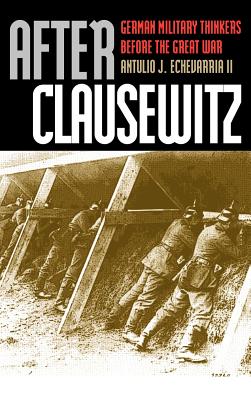
After Clausewitz : German Military Thinkers Before the Great War
Book Details
Format
Hardback
Book Series
Modern War Studies
ISBN-10
0700610715
ISBN-13
9780700610716
Publisher
University Press of Kansas
Imprint
University Press of Kansas
Country of Manufacture
US
Country of Publication
GB
Publication Date
Mar 31st, 2001
Print length
360 Pages
Weight
688 grams
Dimensions
22.90 x 16.30 x 2.90 cms
Product Classification:
Theory of warfare & military scienceTheory of warfare and military science
KSh 8,950.00
Currently unavailable
0 in stock
Delivery Location
Delivery fee: Select location
Secure
Quality
Fast
The Kaiser's military theorists have often been portrayed as narrow-minded thinkers wedded to an outmoded way of war. This book argues that they were fully aware of the implications of advanced weaponry and that the slaughter of World War I was due to deficient training amongst younger officers.
The writings of Carl von Clausewitz loom so large in the annals of military theory that they obscure the substantial contributions of those thinkers who came after him. This is especially true for those German theorists who wrote during the half century preceding World War I. However, as Antulio Echevarria argues, although none of those thinkers approached Clausewitz''s stature, they were nonetheless theorists of considerable vision. The Kaiser''s theorists have long been portrayed as narrow-minded thinkers wedded to an outmoded way of war, little altered since Napoleon''s time. According to this view, they ignored or simply failed to understand how industrialization and modernization had transformed the conduct of war. They seemed unaware of how numerous advances in technology and weaponry had so increased the power of the defensive that decisive victory had become virtually impossible. But Echevarria disputes this traditional view and convincingly shows that these theorists - Boguslawski, Goltz, Schlieffen, Hoenig, and their American and European counterparts - were not the architects of outmoded theories. In fact, they duly appreciated the implications of the vast advances in modern weaponry (as well as in transportation and communications) and set about finding solutions that would restore offensive maneuver to the battlefield. Among other things, they underscored the emerging need for synchronizing concentrated firepower with rapid troop movements, as well as the need for a decentralized command scheme in order to cope with the greater tempo, lethality, and scope of modern warfare. In effect, they redefined the essential relations among the combined arms of infantry, artillery, and cavalry, Echevarria goes on to suggest that attempts to apply new military theories and doctrine were uneven due to deficiencies in training and an overall lack of interest in theory among younger officers. It is this failure of application, more than the theories themselves, that are responsible for the ruinous slaughter of World War I.
Get After Clausewitz at the best price and quality guaranteed only at Werezi Africa's largest book ecommerce store. The book was published by University Press of Kansas and it has 360 pages.
Customers Who Bought This Also Bought
Nuclear War
KSh 2,000.00

Strategy
KSh 4,350.00
The Concise 33 Strategies of War
KSh 2,000.00

The Art of War
KSh 1,100.00
The Prince
KSh 1,450.00

On War
KSh 2,000.00
Just War
KSh 8,650.00

Rearming Europe
KSh 30,950.00

Why Wars Widen
KSh 30,950.00

The South African Intelligence Services
KSh 11,150.00

Outsourcing War
KSh 7,200.00
US Democracy Promotion in the Middle East
KSh 7,550.00
