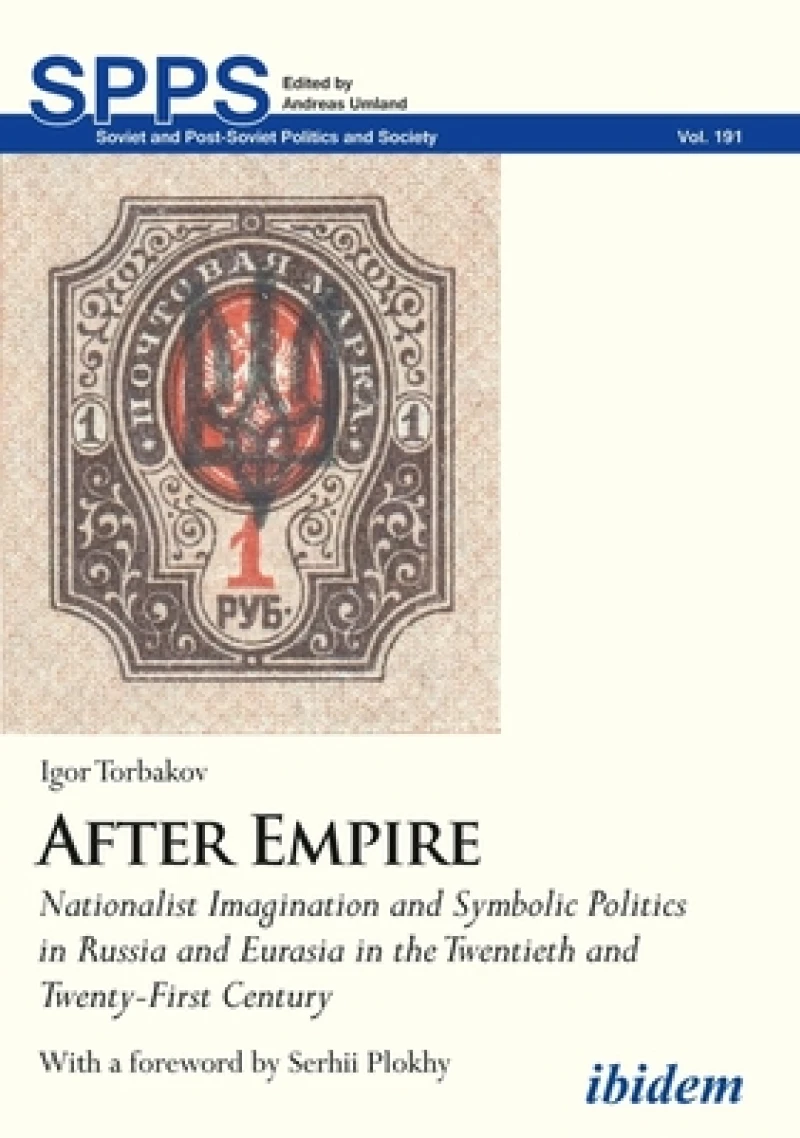
After Empire : Nationalist Imagination and Symbolic Politics in Russia and Eurasia in the Twentieth and Twenty-First Century
New
Book Details
Format
Paperback / Softback
Book Series
Soviet and Post-Soviet Politics and Society
ISBN-10
3838212177
ISBN-13
9783838212173
Edition
New
Publisher
ibidem-Verlag, Jessica Haunschild u Christian Schon
Imprint
ibidem-Verlag, Jessica Haunschild u Christian Scho
Country of Manufacture
DE
Country of Publication
GB
Publication Date
Oct 30th, 2018
Print length
356 Pages
Weight
468 grams
Dimensions
14.90 x 21.10 x 2.10 cms
Ksh 4,700.00
Temporarily out of stock, due soon
0 in stock
Delivery Location
Delivery fee: Select location
Secure
Quality
Fast
Torbakov explores the nexus between various forms of Russian political imagination and the cyclic process of decline and fall of Russia’s imperial polity.
Igor Torbakov explores the nexus between various forms of Russian political imagination and the apparently cyclic process of decline and fall of Russia’s imperial polity over the last hundred years. While Russia’s historical process is by no means unique, two features of its historical development stand out. First, the country’s history is characterized by dramatic political discontinuity. In the past century, Russia changed its “historical skin” three times: following the disintegration of the Tsarist Empire accompanied by violent civil war, it was reconstituted as the communist USSR, whose breakup a quarter century ago led to the emergence of the present-day Russian Federation. Each of the dramatic transformations in the 20th century powerfully affected the notion of what “Russia” is and what it means to be Russian. Second, alongside Russia’s political instability, there is, paradoxically, a striking picture of geopolitical stability and of remarkable longevity as an imperial entity. At least since the beginning of the 18th century, “Russia” has been a permanent geopolitical fixture on Europe’s north-eastern margins with its persistent pretense to the status of a great power. Against this backdrop, the book’s three sections investigate (a) the emergence and development of Eurasianism as a form of (post-)imperial ideology, (b) the crucial role Ukraine has historically played for the Russians’ self-understanding, and (c) the contemporary Russian elites’ exercises in historical legitimation.
Get After Empire by at the best price and quality guaranteed only at Werezi Africa's largest book ecommerce store. The book was published by ibidem-Verlag, Jessica Haunschild u Christian Schon and it has pages.