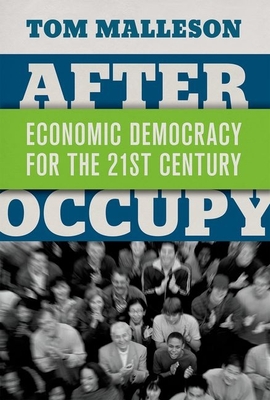
After Occupy : Economic Democracy for the 21st Century
by
Tom Malleson
Book Details
Format
Hardback
ISBN-10
0199330107
ISBN-13
9780199330102
Publisher
Oxford University Press Inc
Imprint
Oxford University Press Inc
Country of Manufacture
GB
Country of Publication
GB
Publication Date
May 29th, 2014
Print length
302 Pages
Weight
638 grams
Dimensions
16.40 x 23.50 x 2.50 cms
Product Classification:
Socialism & left-of-centre democratic ideologiesPolitical structures: democracyPolitical economy
KSh 11,850.00
Temporarily out of stock, due soon
0 in stock
Delivery Location
Delivery fee: Select location
Secure
Quality
Fast
After Occupy scrutinizes power structures in workplaces, markets and investment institutions to boldly argue that democracy shouldn't just be a feature of political institutions but of economic institutions as well.
These days, it is easy to be cynical about democracy. Even though there are more democratic societies now (119 and counting) than ever before, skeptics can point to low turnouts in national elections, the degree to which money corrupts the process, and the difficulties of mass participation in complex systems as just a few reasons the system is flawed. The Occupy movement in 2011 proved that there is an emphatic dissatisfaction with the current state of affairs, particularly with the economy, but, ultimately, it failed to produce any coherent vision for social change. So what should progressives be working toward? What should the economic vision be for the 21st century? After Occupy boldly argues that democracy should not just be a feature of political institutions, but of economic institutions as well. In fact, despite the importance of the economy in democratic societies, there is very little about it that is democratic. Questioning whether the lack of democracy in the economy might be unjust, Tom Malleson scrutinizes workplaces, the market, and financial and investment institutions to consider the pros and cons of democratizing each. He considers examples of successful efforts toward economic democracy enacted across the globe, from worker cooperatives in Spain to credit unions and participatory budgeting measures in Brazil and questions the feasibility of expanding each. The book offers the first comprehensive and radical vision for democracy in the economy, but it is far from utopian. Ultimately, After Occupy offers possibility, demonstrating in a remarkably tangible way that when political democracy evolves to include economic democracy, our societies will have a chance of meaningful equality for all.
Get After Occupy by Tom Malleson at the best price and quality guaranteed only at Werezi Africa's largest book ecommerce store. The book was published by Oxford University Press Inc and it has 302 pages.
Customers Who Bought This Also Bought

The Road to Serfdom
KSh 3,600.00

Political Order and Political Decay
KSh 2,700.00

Capital & Ideology
KSh 3,050.00

Time for Socialism – Dispatches from a World on Fire, 2016–2021
KSh 2,750.00

Reminiscences of the Cuban Revolutionary War
KSh 2,350.00
Futures of Socialism
KSh 2,700.00

Capitalism
KSh 2,700.00

Albert Einstein's "Why Socialism?
KSh 2,900.00

The Lost and Early Writings of James Connolly, 1889-1898
KSh 3,650.00

Marx: Selected Writings
KSh 4,700.00

Sexuality and the Impurity of the State
KSh 2,400.00

Nasser's Blessed Movement
KSh 3,400.00