
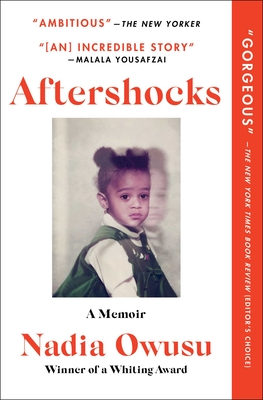
Aftershocks : A Memoir
by
Nadia Owusu
Book Details
Format
Paperback / softback
ISBN-10
1982111232
ISBN-13
9781982111236
Publisher
Simon & Schuster
Imprint
Simon & Schuster
Country of Manufacture
US
Country of Publication
GB
Publication Date
Aug 3rd, 2021
Weight
268 grams
Dimensions
13.90 x 21.20 x 2.50 cms
KSh 3,250.00
Werezi Extended Catalogue
Delivery in 12 days
2 copies in stock
Delivery Location
Delivery fee: Select location
Delivery in 12 days
Secure
Quality
Fast
In the tradition of The Glass Castle, this ?gorgeous? (The New York Times, Editors? Choice) and deeply felt memoir from Whiting Award winner Nadia Owusu tells the ?incredible story? (Malala Yousafzai) about the push and pull of belonging, the seismic emotional toll of family secrets, and the heart it takes to pull through.
?In Aftershocks, Nadia Owusu tells the incredible story of her young life. How does a girl?abandoned by her mother at age two and orphaned at thirteen when her beloved father dies?find her place in the world? This memoir is the story of Nadia creating her own solid ground across countries and continents. I know the struggle of rebuilding your life in an unfamiliar place. While some of you might be familiar with that and some might not, I hope you?ll take as much inspiration and hope from her story as I did.? ?MALALA YOUSAFZAI
?ONE OF THE BEST BOOKS OF 2021 SELECTED BY VULTURE, TIME, ESQUIRE, NPR, AND VOGUE!
Young Nadia Owusu followed her father, a United Nations official, from Europe to Africa and back again. Just as she and her family settled into a new home, her father would tell them it was time to say their goodbyes. The instability wrought by Nadia?s nomadic childhood was deepened by family secrets and fractures, both lived and inherited. Her Armenian American mother, who abandoned Nadia when she was two, would periodically reappear, only to vanish again. Her father, a Ghanaian, the great hero of her life, died when she was thirteen. After his passing, Nadia?s stepmother weighed her down with a revelation that was either a bombshell secret or a lie, rife with shaming innuendo.
With these and other ruptures, Nadia arrived in New York as a young woman feeling stateless, motherless, and uncertain about her future, yet eager to find her own identity. What followed, however, were periods of depression in which she struggled to hold herself and her siblings together.
?A magnificent, complex assessment of selfhood and why it matters? (Elle), Aftershocks depicts the way she hauled herself from the wreckage of her life?s perpetual quaking, the means by which she has finally come to understand that the only ground firm enough to count on is the one written into existence by her own hand.
?Full of narrative risk and untrammeled lyricism? (The Washington Post), Aftershocks joins the likes of Don?t Let?s Go to the Dogs Tonight and William Styron?s Darkness Visible, and does for race identity what Maggie Nelson does for gender identity in The Argonauts.
?In Aftershocks, Nadia Owusu tells the incredible story of her young life. How does a girl?abandoned by her mother at age two and orphaned at thirteen when her beloved father dies?find her place in the world? This memoir is the story of Nadia creating her own solid ground across countries and continents. I know the struggle of rebuilding your life in an unfamiliar place. While some of you might be familiar with that and some might not, I hope you?ll take as much inspiration and hope from her story as I did.? ?MALALA YOUSAFZAI
?ONE OF THE BEST BOOKS OF 2021 SELECTED BY VULTURE, TIME, ESQUIRE, NPR, AND VOGUE!
Young Nadia Owusu followed her father, a United Nations official, from Europe to Africa and back again. Just as she and her family settled into a new home, her father would tell them it was time to say their goodbyes. The instability wrought by Nadia?s nomadic childhood was deepened by family secrets and fractures, both lived and inherited. Her Armenian American mother, who abandoned Nadia when she was two, would periodically reappear, only to vanish again. Her father, a Ghanaian, the great hero of her life, died when she was thirteen. After his passing, Nadia?s stepmother weighed her down with a revelation that was either a bombshell secret or a lie, rife with shaming innuendo.
With these and other ruptures, Nadia arrived in New York as a young woman feeling stateless, motherless, and uncertain about her future, yet eager to find her own identity. What followed, however, were periods of depression in which she struggled to hold herself and her siblings together.
?A magnificent, complex assessment of selfhood and why it matters? (Elle), Aftershocks depicts the way she hauled herself from the wreckage of her life?s perpetual quaking, the means by which she has finally come to understand that the only ground firm enough to count on is the one written into existence by her own hand.
?Full of narrative risk and untrammeled lyricism? (The Washington Post), Aftershocks joins the likes of Don?t Let?s Go to the Dogs Tonight and William Styron?s Darkness Visible, and does for race identity what Maggie Nelson does for gender identity in The Argonauts.
Get Aftershocks by Nadia Owusu at the best price and quality guaranteed only at Werezi Africa's largest book ecommerce store. The book was published by Simon & Schuster.


