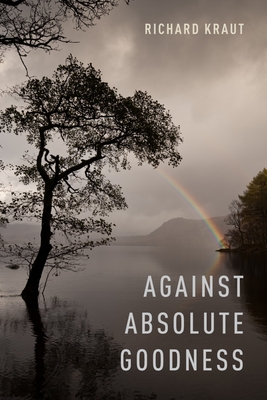
Against Absolute Goodness
Book Details
Format
Hardback
Book Series
Oxford Moral Theory
ISBN-10
0199844461
ISBN-13
9780199844463
Publisher
Oxford University Press Inc
Imprint
Oxford University Press Inc
Country of Manufacture
GB
Country of Publication
GB
Publication Date
Dec 22nd, 2011
Print length
240 Pages
Weight
366 grams
Dimensions
21.40 x 15.00 x 2.20 cms
Product Classification:
Ethics & moral philosophySocial & political philosophy
KSh 15,850.00
Temporarily out of stock, due soon
0 in stock
Delivery Location
Delivery fee: Select location
Secure
Quality
Fast
Are there things we should value because they are, quite simply, good? Richard Kraut argues that there are not. Goodness, he holds, is not a reason-giving property - in fact, there may be no such thing. It is an illusory and insidious category of practical thought.
Are there things we should value because they are, quite simply, good? If so, such things might be said to have "absolute goodness." They would be good simpliciter or full stop - not good for someone, not good of a kind, but nonetheless good (period). They might also be called "impersonal values." The reason why we ought to value such things, if there are any, would merely be the fact that they are, quite simply, good things. In the twentieth century, G. E. Moore was the great champion of absolute goodness, but he is not the only philosopher who posits the existence and importance of this property. Against these friend of absolute goodness, Richard Kraut here builds the argument he made in WHAT IS GOOD AND WHY, demonstrating that goodness is not a reason-giving property - in fact, there may be no such thing. It is, he holds, an insidious category of practical thought, because it can be and has been used to justify what is harmful and condemn what is beneficial. Impersonal value draws us away from what is good for persons. His strategy for opposing absolute goodness is to search for domains of practical reasoning in which it might be thought to be needed, and this leads him to an examination of a wide variety of moral phenomena: pleasure, knowledge, beauty, love, cruelty, suicide, future generations, bio-diversity, killing in self-defense, and the extinction of our species. Even persons, he proposes, should not be said to have absolute value. The special importance of human life rests instead on the great advantages that such lives normally offer. "When one reads this, one sees the possibility of real philosophical progress. If Kraut is right, I''d be wrong to say that this book is good, period. Or even great, period. But I will say that, as a work of philosophy, and for those who read it, it is excellent indeed." - Russ Shafer-Landau, Philosophy, University of Wisconsin-Madison
Get Against Absolute Goodness by Richard Kraut at the best price and quality guaranteed only at Werezi Africa's largest book ecommerce store. The book was published by Oxford University Press Inc and it has 240 pages.
Customers Who Bought This Also Bought
Xmeditations
KSh 700.00
Groundwork for the Metaphysics of Morals
KSh 2,000.00

On the Genealogy of Morals
KSh 2,000.00
Beyond Good and Evil
KSh 2,000.00
The Nicomachean Ethics
KSh 1,600.00
The Sovereignty of Good
KSh 5,400.00

Justice
KSh 2,000.00
Meditations
KSh 1,600.00
What We Owe The Future
KSh 2,000.00
The Analects
KSh 2,350.00
How to Be a Leader – An Ancient Guide to Wise Leadership
KSh 2,800.00
There Are Places in the World Where Rules Are Less Important Than Kindness
KSh 3,600.00