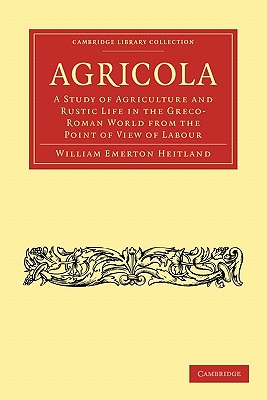
Agricola : A Study of Agriculture and Rustic Life in the Greco-Roman World from the Point of View of Labour
Book Details
Format
Paperback / softback
Book Series
Cambridge Library Collection - Classics
ISBN-10
1108028950
ISBN-13
9781108028950
Publisher
Cambridge University Press
Imprint
Cambridge University Press
Country of Manufacture
GB
Country of Publication
GB
Publication Date
Jun 30th, 2011
Print length
508 Pages
Weight
796 grams
Dimensions
22.90 x 15.30 x 3.10 cms
KSh 8,550.00
Currently unavailable
0 in stock
Delivery Location
Delivery fee: Select location
Secure
Quality
Fast
Published in 1921, Heitland's Agricola is an important sourcebook for social and economic historians of the ancient world. He makes use of a wide range of literary and historical sources covering over twelve hundred years, to assess how agricultural labour was organised, placing it in its social and legal context.
William Emerton Heitland (1847–1935) was a Cambridge classicist, who was described as having 'a passionate desire to attain the truth'. His most distinguished work, Agricola, published in 1921, is a detailed study of agricultural labour in classical times. He makes use of a wide range of sources, from Homer in the eighth century BCE to Apollinaris Sidonius in the fifth century CE. In asking the question, by whom and under what conditions was the work done, he deals with land tenure, taxation, military service and political theory. He argues that changes in agricultural production were necessarily connected to changes in other areas of society. To a large extent, classical agriculture was based on slavery, and even those who were free tenants had limited legal rights. Roman poets such as Virgil idealised the pastoral life, but may not reflect reality. It is an important sourcebook for social and economic history.
Get Agricola by William Emerton Heitland at the best price and quality guaranteed only at Werezi Africa's largest book ecommerce store. The book was published by Cambridge University Press and it has 508 pages.
Customers Who Bought This Also Bought
Agricola and the Germania
KSh 2,350.00

The History of the Kings of Britain
KSh 2,350.00
The History of the Peloponnesian War
KSh 2,700.00
Greek Lives
KSh 2,150.00
How to Be a Leader – An Ancient Guide to Wise Leadership
KSh 2,800.00
The Storm Before the Storm
KSh 3,050.00
Servus
KSh 4,500.00
All Roads Lead to Rome
KSh 2,000.00
Decline and Fall of the Roman Empire
KSh 1,900.00
A History of the Roman Empire in 21 Women
KSh 2,150.00
Decline and Fall of the Roman Empire: Vols 4-6
KSh 10,850.00
The History of the Decline and Fall of the Roman Empire
KSh 4,500.00