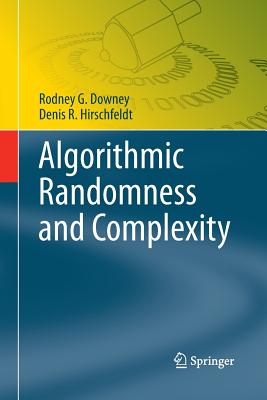
Algorithmic Randomness and Complexity
Softcover reprint of the original 1st ed. 2010
Book Details
Format
Paperback / softback
Book Series
Theory and Applications of Computability
ISBN-10
1493938207
ISBN-13
9781493938209
Edition
Softcover reprint of the original 1st ed. 2010
Publisher
Springer-Verlag New York Inc.
Imprint
Springer-Verlag New York Inc.
Country of Manufacture
GB
Country of Publication
GB
Publication Date
Aug 23rd, 2016
Print length
855 Pages
Weight
1,310 grams
Dimensions
23.50 x 15.70 x 5.00 cms
Product Classification:
Algorithms & data structuresAlgorithms and data structuresMathematical theory of computation
KSh 17,350.00
Currently unavailable
0 in stock
Delivery Location
Delivery fee: Select location
Secure
Quality
Fast
The theory of algorithmic randomness uses tools from computability theory and algorithmic information theory to address questions such as these. It will be of interest to researchers and students in computability theory, algorithmic information theory, and theoretical computer science.
Intuitively, a sequence such as 101010101010101010… does not seem random, whereas 101101011101010100…, obtained using coin tosses, does. How can we reconcile this intuition with the fact that both are statistically equally likely? What does it mean to say that an individual mathematical object such as a real number is random, or to say that one real is more random than another? And what is the relationship between randomness and computational power. The theory of algorithmic randomness uses tools from computability theory and algorithmic information theory to address questions such as these. Much of this theory can be seen as exploring the relationships between three fundamental concepts: relative computability, as measured by notions such as Turing reducibility; information content, as measured by notions such as Kolmogorov complexity; and randomness of individual objects, as first successfully defined by Martin-Löf. Although algorithmic randomness has been studied for several decades, a dramatic upsurge of interest in the area, starting in the late 1990s, has led to significant advances. This is the first comprehensive treatment of this important field, designed to be both a reference tool for experts and a guide for newcomers. It surveys a broad section of work in the area, and presents most of its major results and techniques in depth. Its organization is designed to guide the reader through this large body of work, providing context for its many concepts and theorems, discussing their significance, and highlighting their interactions. It includes a discussion of effective dimension, which allows us to assign concepts like Hausdorff dimension to individual reals, and a focused but detailed introduction to computability theory. It will be of interest to researchers and students in computability theory, algorithmic information theory, and theoretical computer science.
Get Algorithmic Randomness and Complexity by Denis R. Hirschfeldt, Rodney G. Downey at the best price and quality guaranteed only at Werezi Africa's largest book ecommerce store. The book was published by Springer-Verlag New York Inc. and it has 855 pages.
Customers Who Bought This Also Bought

Machine Learning with Python
KSh 14,750.00

Numerical Analysis
KSh 14,150.00
Numerical Nonsmooth Optimization
KSh 28,800.00
Cryptographic Engineering
KSh 39,600.00
Computability and Complexity Theory
KSh 13,500.00
Randomized Algorithms
KSh 14,650.00
Stochastic Approximation and Recursive Algorithms and Applications
KSh 32,400.00

Information Processing and Management of Uncertainty in Knowledge-Based Systems
KSh 19,800.00
Small Summaries for Big Data
KSh 9,550.00
Skew PBW Extensions
KSh 19,800.00
Handbook of Approximation Algorithms and Metaheuristics
KSh 10,500.00
Applications of Flower Pollination Algorithm and its Variants
KSh 23,400.00