
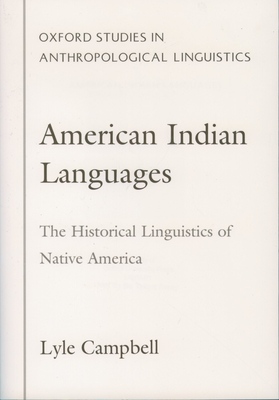
American Indian Languages : The Historical Linguistics of Native America
by
Campbell
Book Details
Format
Paperback / softback
Book Series
Oxford Studies in Anthropological Linguistics
ISBN-10
0195140508
ISBN-13
9780195140507
Publisher
Oxford University Press Inc
Imprint
Oxford University Press Inc
Country of Manufacture
GB
Country of Publication
GB
Publication Date
Oct 12th, 2000
Print length
528 Pages
Weight
962 grams
Dimensions
24.10 x 18.90 x 2.80 cms
Product Classification:
Historical & comparative linguistics
KSh 20,050.00
Temporarily out of stock, due soon
0 in stock
Delivery Location
Delivery fee: Select location
Secure
Quality
Fast
Campbell's project is to take stock of what is currently known about the history and classification of Native American Languages and in the process examine the state of American Indian historical linguistics, and the success and failure of its various methodologies.
Native American languages are spoken from Siberia to Greenland, and from the Arctic to Tierra del Fuego; they include the southernmost language of the world (Yaghan) and some of the northernmost (Eskimoan). Campbell''s project is to take stock of what is currently known about the history of Native American languages and in the process examine the state of American-Indian historical linguistics, and the success and failure of its various methodologies. There is remarkably little consensus in the field, largely due to the 1987 publication of Language in the Americas by Joseph Greenberg. He claimed to trace a historical relation between all American Indian languages of North and South America, implying that most of the Western Hemisphere was settled by a single wave of immigration from Asia. This has caused intense controversy and Campbell, as a leading scholar in the field, intends this volume to be, in part, a response to Greenberg. Finally, Campbell demonstrates that the historical study of Native American languages has always relied on up-to-date methodology and theoretical assumptions and did not, as is often believed, lag behind the European historical linguistic tradition.
Native American languages are spoken from Siberia to Greenland, and from the Arctic to Tierra del Fuego; they include the southernmost language of the world (Yaghan) and some of the northernmost (Eskimoan). Campbell''s project is to take stock of what is currently known about the history of Native American languages and in the process examine the state of American Indian historical linguistics, and the success and failure of its various methodologies. There is remarkably little consensus in the field, largely due to the 1987 publication of Language in the Americas by Joseph Greenberg. He claimed to trace a historical relation between all American Indian languages of North and South America, implying that most of the Western Hemisphere was settled by a single wave of immigration from Asia. This has caused intense controversy and Campbell, as a leading scholar in the field, intends this volume to be, in part, a response to Greenberg. Finally, Campbell demonstrates that the historical study of Native American languages has always relied on up-to-date methodology and theoretical assumptions and did not, as is often believed, lag behind the European historical linguistic tradition.
Get American Indian Languages by Campbell at the best price and quality guaranteed only at Werezi Africa's largest book ecommerce store. The book was published by Oxford University Press Inc and it has 528 pages.
Customers Who Bought This Also Bought

Adventure Of English
KSh 2,350.00

Naming of the Shrew
KSh 2,000.00

The Names of Science
KSh 7,850.00

A Grammar of Teotitlan del Valle Zapotec
KSh 28,100.00

Romania Africana
KSh 32,750.00
You All Spoken Here
KSh 4,950.00

A Comparative Analysis of Classifier-Noun Structures in Chinese and English
KSh 32,000.00

Indo-Scythian Studies, Volume VI
KSh 9,750.00

African Englishes and Multilingualism for the Transformative Development of Postcolonial Africa
KSh 6,100.00

Morphologische Untersuchungen Auf Dem Gebiete Der Indogermanischen Sprachen
KSh 7,200.00

Interactions across Englishes
KSh 18,700.00
Semantic Interpretation and the Resolution of Ambiguity
KSh 7,600.00
More by Campbell

Gun Sireadh, Gun Iarraidh - The Tolmie Collection
KSh 4,400.00
1 Samuel
KSh 8,300.00

Gun Sireadh, Gun Iarraidh - The Tolmie Collection
KSh 4,400.00

Shazam Vol 4 Welcome To Our Overlords
KSh 3,050.00

A New Song
KSh 4,500.00

Public Assistance Data Bk CB
KSh 2,500.00

John Milton
KSh 3,350.00

Electrical Properties of the Earth S Mantle
KSh 8,100.00

Marriage and Family in the Biblical World
KSh 5,050.00

Celtic Dragon Myth
KSh 4,850.00

Celtic Dragon Myth
KSh 13,550.00
