
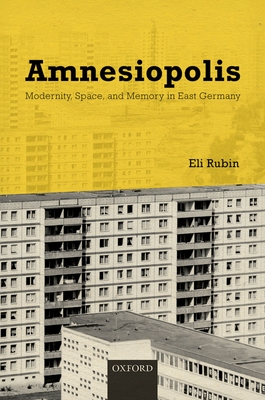
Amnesiopolis : Modernity, Space, and Memory in East Germany
by
Eli Rubin
Book Details
Format
Hardback
ISBN-10
0198732260
ISBN-13
9780198732266
Publisher
Oxford University Press
Imprint
Oxford University Press
Country of Manufacture
GB
Country of Publication
GB
Publication Date
Feb 4th, 2016
Print length
210 Pages
Weight
464 grams
Dimensions
16.40 x 24.20 x 1.90 cms
KSh 18,500.00
Temporarily out of stock, due soon
0 in stock
Delivery Location
Delivery fee: Select location
Secure
Quality
Fast
Identical concrete housing blocks are an iconic legacy of life behind the Iron Curtain. Amnesiopolis studies the construction of Marzahn, the largest prefabricated housing project in East Germany, asking whether a move from 19th century slums to functional socialist housing offered a radical break from Germany's individual and collective pasts.
Amnesiopolis explores the construction of Marzahn, the largest prefabricated housing project in East Germany, built on the outskirts of East Berlin in the 1970s and 1980s, and touted by the regime as the future of socialism. It focuses particularly on the experience of East Germans who moved, often from crumbling slums left over as a legacy of the nineteenth century, into this radically new place - one defined by pure functionality and rationality - a material manifestation of the utopian promise of socialism.Eli Rubin employs methodologies from critical geography, urban history, architectural history, environmental history, and everyday life history to ask whether their experience was a radical break with their personal pasts and the German past. Amnesiopolis asks: can a dramatic change in spatial and material surroundings sever the links of memory that tie people to their old life narratives, and if so, does that help build a new socialist mentality in the minds of historical subjects? The answer is yes and no-as much as the East German state tried to create a completely new socialist settlement, divorced of any links to the pre-socialist past, the massive construction project uncovered the truth buried-literally-in the ground, which was that the urge to colonize the outskirts of Berlin was not new at all. Furthermore, the construction of a new city out of nothing, using repeating, identical buildings, created a panopticon-like effect, giving the Stasi the possibility of more complete surveillance than they previously had.
Get Amnesiopolis by Eli Rubin at the best price and quality guaranteed only at Werezi Africa's largest book ecommerce store. The book was published by Oxford University Press and it has 210 pages.
Customers Who Bought This Also Bought

Age of Revolutions
KSh 2,350.00

Eichmann in Jerusalem
KSh 2,350.00

Trouble With Being Born
KSh 2,000.00

Hiroshima
KSh 2,000.00

Freedom
KSh 6,300.00

Holocaust
KSh 2,700.00
The History of the Peloponnesian War
KSh 2,700.00
Annals
KSh 2,350.00
Greek Lives
KSh 2,150.00
Sleepwalkers
KSh 3,400.00

Napoleon The Great
KSh 3,600.00
Diary of a Young Girl
KSh 1,800.00

