
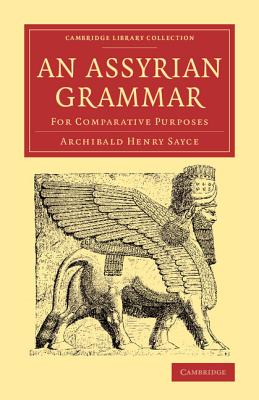
An Assyrian Grammar : For Comparative Purposes
Book Details
Format
Paperback / softback
Book Series
Cambridge Library Collection - Linguistics
ISBN-10
1108077927
ISBN-13
9781108077927
Publisher
Cambridge University Press
Imprint
Cambridge University Press
Country of Manufacture
GB
Country of Publication
GB
Publication Date
Oct 30th, 2014
Print length
210 Pages
Weight
276 grams
Dimensions
13.80 x 21.50 x 1.60 cms
Product Classification:
Historical & comparative linguisticsHistorical and comparative linguistics
KSh 5,000.00
Currently unavailable
0 in stock
Delivery Location
Delivery fee: Select location
Secure
Quality
Fast
The philologist Archibald Henry Sayce (1845–1933) had studied Middle Eastern languages and scripts since adolescence. In this 1872 grammar, using transliteration rather than cuneiform, Sayce first considers the place of Assyrian in the Semitic language family and its development over time, then presents its phonology, morphology, syntax and prosody.
Archibald Henry Sayce (1845–1933) became interested in Middle Eastern languages and scripts while still a teenager. Old Persian and Akkadian cuneiform had recently been deciphered, and at the same time Indo-European studies had emerged as a lively field, with publications by scholars including Grimm, Bopp and Schleicher. Assyrian offered opportunities to historians of the Semitic languages similar to those provided by Avestan to Indo-Europeanists, and Sayce's grammar, published in 1872, was aimed at such an audience. Only transliteration was used, as cuneiform would be both expensive and redundant for philological purposes. In his preface, Sayce acknowledges the recent work of Oppert, Hincks, and Smith (whose translation of part of the epic tale of Gilgamesh attracted considerable publicity later that year). Sayce considers the place of Assyrian in the Semitic language family and its development over time, and reviews the archaeological evidence and scholarly literature, before presenting its phonology, morphology, syntax and prosody.
Get An Assyrian Grammar by Archibald Henry Sayce at the best price and quality guaranteed only at Werezi Africa's largest book ecommerce store. The book was published by Cambridge University Press and it has 210 pages.
Customers Who Bought This Also Bought

Adventure Of English
KSh 2,350.00

Naming of the Shrew
KSh 2,000.00
The Names of Science
KSh 7,850.00

A Grammar of Teotitlan del Valle Zapotec
KSh 28,100.00

Romania Africana
KSh 32,750.00

You All Spoken Here
KSh 4,950.00

A Comparative Analysis of Classifier-Noun Structures in Chinese and English
KSh 32,000.00
Indo-Scythian Studies, Volume VI
KSh 9,750.00

African Englishes and Multilingualism for the Transformative Development of Postcolonial Africa
KSh 6,100.00
Morphologische Untersuchungen Auf Dem Gebiete Der Indogermanischen Sprachen
KSh 7,200.00
Interactions across Englishes
KSh 18,700.00
Semantic Interpretation and the Resolution of Ambiguity
KSh 7,600.00
More by Archibald Henry Sayce
A Primer of Assyriology
KSh 3,800.00
Lectures Upon the Assyrian Language and Syllabary
KSh 4,850.00
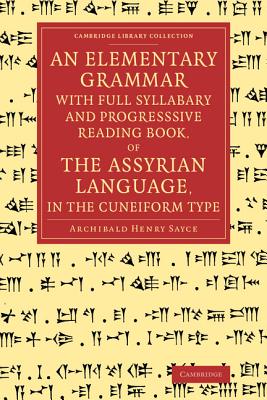
An Elementary Grammar with Full Syllabary and Progresssive Reading Book, of the Assyrian Language, in the Cuneiform Type
KSh 3,900.00
The Principles of Comparative Philology
KSh 6,750.00
The Archaeology of the Cuneiform Inscriptions
KSh 4,750.00
Babylonians and Assyrians
KSh 5,150.00
Patriarchal Palestine
KSh 4,700.00
