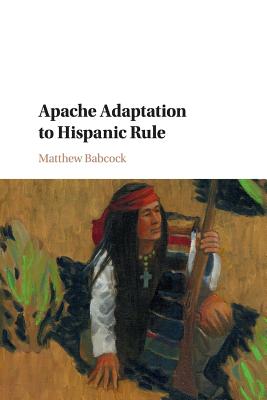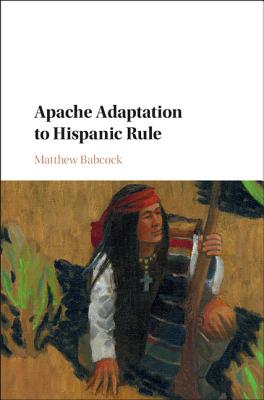
Apache Adaptation to Hispanic Rule
Book Details
Format
Hardback
Book Series
Studies in North American Indian History
ISBN-10
1107121388
ISBN-13
9781107121386
Publisher
Cambridge University Press
Imprint
Cambridge University Press
Country of Manufacture
US
Country of Publication
GB
Publication Date
Sep 26th, 2016
Print length
315 Pages
Weight
584 grams
Dimensions
16.40 x 23.70 x 2.60 cms
KSh 9,950.00
Publisher Out of Stock
0 in stock
Delivery Location
Delivery fee: Select location
Secure
Quality
Fast
Aimed at scholars of American Indians, early North America, and colonial Mexico, this book explores how Apache groups negotiated peace and adapted to Spanish and Mexican colonialism. Adopting an interdisciplinary approach, it combines Spanish documents from archives in Spain, Mexico, and the US, with anthropology, archaeology, and Ndé (Apache) oral history.
As a definitive study of the poorly understood Apaches de paz, this book explains how war-weary, mutually suspicious Apaches and Spaniards negotiated an ambivalent compromise after 1786 that produced over four decades of uneasy peace across the region. In response to drought and military pressure, thousands of Apaches settled near Spanish presidios in a system of reservation-like establecimientos, or settlements, stretching from Laredo to Tucson. Far more significant than previously assumed, the establecimientos constituted the earliest and most extensive set of military-run reservations in the Americas and served as an important precedent for Indian reservations in the United States. As a case study of indigenous adaptation to imperial power on colonial frontiers and borderlands, this book reveals the importance of Apache-Hispanic diplomacy in reducing cross-cultural violence and the limits of indigenous acculturation and assimilation into empires and states.
Get Apache Adaptation to Hispanic Rule by Matthew Babcock at the best price and quality guaranteed only at Werezi Africa's largest book ecommerce store. The book was published by Cambridge University Press and it has 315 pages.
Customers Who Bought This Also Bought

Crusade for Justice – The Autobiography of Ida B. Wells, Second Edition
KSh 4,050.00

Killers of the Flower Moon
KSh 2,000.00

Warmth of Other Suns
KSh 3,050.00

Frederick Douglass
KSh 3,350.00

107 Days
KSh 4,500.00

Second Treatise of Government – Norton Library
KSh 1,600.00

Tuesdays With Morrie
KSh 2,000.00
My Bondage and My Freedom
KSh 1,600.00

Hidden Figures
KSh 2,000.00

America, América
KSh 3,650.00

Holding the Line
KSh 2,000.00

Nuclear Folly
KSh 3,050.00