
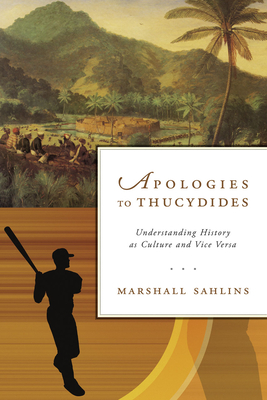
Apologies to Thucydides : Understanding History as Culture and Vice Versa
Book Details
Format
Paperback / softback
ISBN-10
022610382X
ISBN-13
9780226103822
Publisher
The University of Chicago Press
Imprint
University of Chicago Press
Country of Manufacture
US
Country of Publication
GB
Publication Date
Nov 11th, 2013
Print length
348 Pages
Weight
584 grams
Dimensions
22.90 x 15.80 x 2.60 cms
Product Classification:
HistoriographyAnthropology
KSh 4,850.00
Currently unavailable
0 in stock
Delivery Location
Delivery fee: Select location
Secure
Quality
Fast
Presents Thucydides' classic work on the history of the Peloponnesian War that is the root of Western conceptions of history - including the ethnocentric idea that Thucydides' historiography was universally valid, applicable to all societies at all times.
Thucydides'' classic work on the history of the Peloponnesian War is the root of Western conceptions of historyincluding the idea that Western history is the foundation of everyone else''s. Here, Marshall Sahlins takes on Thucydides and the conceptions of history he wrought with a groundbreaking new book that shows what a difference an anthropological concept of culture can make to the writing of history.
Sahlins begins by confronting Thucydides'' account of the Peloponnesian War with an analogous "Polynesian War," the fight for the domination of the Fiji Islands (1843-55) between a great sea power (like Athens) and a great land power (like Sparta). Sahlins draws parallels between the conflicts with an eye to their respective systems of power and sovereignty as well as to Thucydides'' alternation between individual (Pericles, Themistocles) and collective (the Athenians, the Spartans) actors in the making of history. Characteristic of most histories ever written, this alternation between the agency of "Great Men" and collective entities leads Sahlins to a series of incisive analyses ranging in subject matter from Bobby Thomson''s "shot heard round the world" for the 1951 Giants to the history-making of Napoleon and certain divine kings to the brouhaha over Elián Gonzalez. Finally, again departing from Thucydides, Sahlins considers the relationship between cultural order and historical contingency through the recounting of a certain royal assassination that changed the course of Fijian history, a story of fratricide and war worthy of Shakespeare.
In this most convincing presentation yet of his influential theory of culture, Sahlins experiments with techniques for mixing rich narrative with cultural explication in the hope of doing justice at once to the actions of persons and the customs of people. And he demonstrates the necessity of taking culture into account in the creation of historywith apologies to Thucydides, who too often did not.
Sahlins begins by confronting Thucydides'' account of the Peloponnesian War with an analogous "Polynesian War," the fight for the domination of the Fiji Islands (1843-55) between a great sea power (like Athens) and a great land power (like Sparta). Sahlins draws parallels between the conflicts with an eye to their respective systems of power and sovereignty as well as to Thucydides'' alternation between individual (Pericles, Themistocles) and collective (the Athenians, the Spartans) actors in the making of history. Characteristic of most histories ever written, this alternation between the agency of "Great Men" and collective entities leads Sahlins to a series of incisive analyses ranging in subject matter from Bobby Thomson''s "shot heard round the world" for the 1951 Giants to the history-making of Napoleon and certain divine kings to the brouhaha over Elián Gonzalez. Finally, again departing from Thucydides, Sahlins considers the relationship between cultural order and historical contingency through the recounting of a certain royal assassination that changed the course of Fijian history, a story of fratricide and war worthy of Shakespeare.
In this most convincing presentation yet of his influential theory of culture, Sahlins experiments with techniques for mixing rich narrative with cultural explication in the hope of doing justice at once to the actions of persons and the customs of people. And he demonstrates the necessity of taking culture into account in the creation of historywith apologies to Thucydides, who too often did not.
Get Apologies to Thucydides by Marshall Sahlins at the best price and quality guaranteed only at Werezi Africa's largest book ecommerce store. The book was published by The University of Chicago Press and it has 348 pages.
Customers Who Bought This Also Bought
Servus
KSh 4,500.00

Saladin
KSh 5,000.00

Islam and World History
KSh 5,050.00

Zionism
KSh 4,300.00

Theorising the Artist Interview
KSh 30,950.00

Echoes of the Marseillaise
KSh 2,700.00

Shapers of Southern History
KSh 18,000.00

Thucydides
KSh 5,600.00

Hearing History
KSh 9,200.00

C. Vann Woodward, Southerner
KSh 6,300.00

At the Nexus of Philosophy and History
KSh 5,600.00

Making Black History
KSh 17,400.00
More by Marshall Sahlins

What the Foucault? 6e
KSh 1,800.00

Stone Age Economics
KSh 9,250.00

Stone Age Economics
KSh 12,250.00

Stone Age Economics
KSh 3,800.00

Culture in Practice
KSh 5,300.00

How "Natives" Think
KSh 6,400.00

What Kinship Is–And Is Not
KSh 2,950.00

On Kings
KSh 5,900.00

The New Science of the Enchanted Universe – An Anthropology of Most of Humanity
KSh 5,750.00

Confucius Institutes – Academic Malware
KSh 1,800.00

Waiting for Foucault, Still
KSh 1,800.00

The Western Illusion of Human Nature – With Reflections on the Long History of Hierarchy, Equality and the Sublimation of Anarchy in the Wes
KSh 2,000.00
