
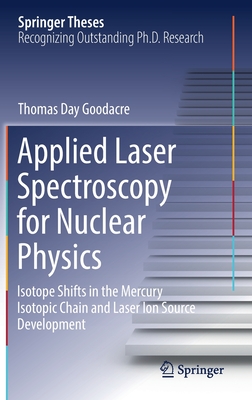
Applied Laser Spectroscopy for Nuclear Physics : Isotope Shifts in the Mercury Isotopic Chain and Laser Ion Source Development
2021 ed.
Book Details
Format
Hardback
Book Series
Springer Theses
ISBN-10
3030738884
ISBN-13
9783030738884
Edition
2021 ed.
Publisher
Springer Nature Switzerland AG
Imprint
Springer Nature Switzerland AG
Country of Manufacture
GB
Country of Publication
GB
Publication Date
Sep 27th, 2021
Print length
129 Pages
Weight
344 grams
Dimensions
24.40 x 16.10 x 1.40 cms
KSh 23,400.00
Currently unavailable
0 in stock
Delivery Location
Delivery fee: Select location
Secure
Quality
Fast
This thesis explores two distinct applications of laser spectroscopy: the study of nuclear ground state properties, and element selective radioactive ion beam production. It also presents the methods and results of an investigation into isotope shifts in the mercury isotopic chain. These Resonance Ionization Laser Ion Source (RILIS) developments are detailed, together with an RILIS ionization scheme that allowed laser ionized ion beams of chromium, germanium, radium and tellurium to be generated at the Isotope Mass Separator On-Line (ISOLDE) facility. A combination of laser spectroscopy with decay spectroscopy and mass spectrometry unambiguously demonstrated a cessation of the extreme shape staggering first observed in the 1970s and revealed the characteristic kink at the crossing of the N=126 shell closure. A series of RILIS developments were required to facilitate this experiment, including mercury “ionization scheme” development and the coupling of the RILIS with an arc discharge ion source. Laser spectroscopy has since become a powerful tool for nuclear physics and the Resonance Ionization Laser Ion Source (RILIS), of the ISOLDE facility at CERN, is a prime example. Highlighting important advances in this field, the thesis offers a unique and revealing resource.
Get Applied Laser Spectroscopy for Nuclear Physics by Thomas Day Goodacre at the best price and quality guaranteed only at Werezi Africa's largest book ecommerce store. The book was published by Springer Nature Switzerland AG and it has 129 pages.
Customers Who Bought This Also Bought

The Making Of The Atomic Bomb
KSh 3,550.00

Short History of Nearly Everything 2.0
KSh 3,550.00

Hiroshima Men
KSh 4,500.00
Plasma Atomic Physics
KSh 25,200.00

Industrial X-Ray Computed Tomography
KSh 19,800.00
Thoria-based Nuclear Fuels
KSh 16,200.00

Secondary Emission and Structural Properties of Solids
KSh 8,100.00

Advances in the Application of Lasers in Materials Science
KSh 19,800.00

Particle Confinement in Penning Traps
KSh 18,000.00

Lehrbuch zur Experimentalphysik Band 2: Kontinuumsmechanik und Thermodynamik
KSh 5,400.00

Theory of Atomic and Molecular Clusters
KSh 12,950.00

Optical Coherence Tomography
KSh 16,200.00

