
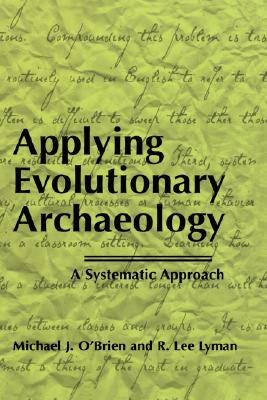
Applying Evolutionary Archaeology : A Systematic Approach
2000 ed.
Book Details
Format
Hardback
ISBN-10
0306462532
ISBN-13
9780306462535
Edition
2000 ed.
Publisher
Springer Science+Business Media
Imprint
Plenum Publishing Co.,N.Y.
Country of Manufacture
US
Country of Publication
GB
Publication Date
Mar 31st, 2000
Print length
471 Pages
Product Classification:
ArchaeologyArchaeology
KSh 23,400.00
Currently unavailable
0 in stock
Delivery Location
Delivery fee: Select location
Secure
Quality
Fast
After one of the preeminent (and often vilified) social scientists of the nineteenth century, Herbert Spencer, popularized the term in the 1850s, evolution became more or less a household word, usually being used synonymously with change, albeit change over extended periods of time.
Anthropology, and by extension archaeology, has had a long-standing interest in evolution in one or several of its various guises. Pick up any lengthy treatise on humankind written in the last quarter of the nineteenth century and the chances are good that the word evolution will appear somewhere in the text. If for some reason the word itself is absent, the odds are excellent that at least the concept of change over time will have a central role in the discussion. After one of the preeminent (and often vilified) social scientists of the nineteenth century, Herbert Spencer, popularized the term in the 1850s, evolution became more or less a household word, usually being used synonymously with change, albeit change over extended periods of time. Later, through the writings of Edward Burnett Tylor, Lewis Henry Morgan, and others, the notion of evolution as it applies to stages of social and political development assumed a prominent position in anthropological disc- sions. To those with only a passing knowledge of American anthropology, it often appears that evolutionism in the early twentieth century went into a decline at the hands of Franz Boas and those of similar outlook, often termed particularists. However, it was not evolutionism that was under attack but rather comparativism- an approach that used the ethnographic present as a key to understanding how and why past peoples lived the way they did (Boas 1896).
Get Applying Evolutionary Archaeology by Michael J. O'Brien, R. Lee Lyman at the best price and quality guaranteed only at Werezi Africa's largest book ecommerce store. The book was published by Springer Science+Business Media and it has 471 pages.
Customers Who Bought This Also Bought
Servus
KSh 4,500.00

Memoirs of the Marquis of Torcy, Secretary of State to Lewis XIV. Containing the history of the negotiations from the Treaty of Ryswic to the Peace of Utrecht. Translated from the French. ... Volume 1 of 2
KSh 4,050.00
Memoirs of the Marquis of Torcy, Secretary of State to Lewis XIV. Containing the history of the negotiations from the Treaty of Ryswic to the Peace of Utrecht. Translated from the French. ... Volume 2 of 2
KSh 3,750.00

The Biggest Prison on Earth
KSh 2,350.00

The Stated Motivations for the Early Islamic Expansion (622–641)
KSh 16,250.00
Introducing Anthropology – What Makes Us Human?
KSh 5,250.00

Rousseau: The Social Contract and Other Later Political Writings
KSh 4,500.00
The History of Kamtschatka, and the Kurilski Islands, with the Countries Adjacent; Illustrated with Maps and Cuts. Published at Petersbourg in the Russian Language, ... and Translated Into English by James Grieve, M.D.
KSh 3,650.00

The Persians – Lost Civilizations
KSh 2,700.00

Edward I and Wales, 1254-1307
KSh 4,500.00

Plantagenet Princes
KSh 2,350.00
St. Catherines
KSh 3,700.00
More by Michael J. O'Brien, R. Lee Lyman
Mississippian Community Organization
KSh 16,200.00

Collaborators through Time
KSh 4,400.00

Fundamental Archaeological Concepts
KSh 18,250.00
Paleozoology and Paleoenvironments
KSh 7,600.00
Vertebrate Taphonomy
KSh 13,000.00
Quantitative Paleozoology
KSh 8,200.00
Theodore E. White and the Development of Zooarchaeology in North America
KSh 8,300.00
Paleozoology and Paleoenvironments
KSh 20,500.00
Graphing Culture Change in North American Archaeology
KSh 24,900.00
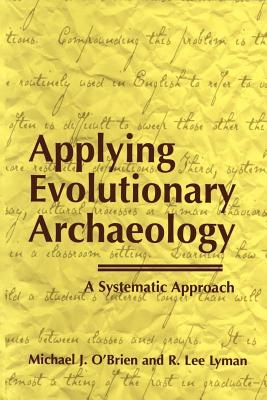
Applying Evolutionary Archaeology
KSh 23,400.00
More in This Genre
Servus
KSh 4,500.00
Memoirs of the Marquis of Torcy, Secretary of State to Lewis XIV. Containing the history of the negotiations from the Treaty of Ryswic to the Peace of Utrecht. Translated from the French. ... Volume 1 of 2
KSh 4,050.00
Memoirs of the Marquis of Torcy, Secretary of State to Lewis XIV. Containing the history of the negotiations from the Treaty of Ryswic to the Peace of Utrecht. Translated from the French. ... Volume 2 of 2
KSh 3,750.00
The Biggest Prison on Earth
KSh 2,350.00
The Stated Motivations for the Early Islamic Expansion (622–641)
KSh 16,250.00
Introducing Anthropology – What Makes Us Human?
KSh 5,250.00
