Search

Categories

    • categories-img Jacket, Women
    • categories-img Woolend Jacket
    • categories-img Western denim
    • categories-img Mini Dresss
    • categories-img Jacket, Women
    • categories-img Woolend Jacket
    • categories-img Western denim
    • categories-img Mini Dresss
    • categories-img Jacket, Women
    • categories-img Woolend Jacket
    • categories-img Western denim
    • categories-img Mini Dresss
    • categories-img Jacket, Women
    • categories-img Woolend Jacket
    • categories-img Western denim
    • categories-img Mini Dresss
    • categories-img Jacket, Women
    • categories-img Woolend Jacket
    • categories-img Western denim
    • categories-img Mini Dresss

Filter By Price

$
-
$

Dietary Needs

Top Rated Product

product-img product-img

Modern Chair

$165.00
product-img product-img

Plastic Chair

$165.00
product-img product-img

Design Rooms

$165.00

Brands

  • Wooden
  • Chair
  • Modern
  • Fabric
  • Shoulder
  • Winter
  • Accessories
  • Dress

Welcome and thank you for visiting us. For any query call us on 0799 626 359 or Email [email protected]

Offcanvas Menu Open

Shopping Cart

Africa largest book store

Sub Total:

Search for any Title

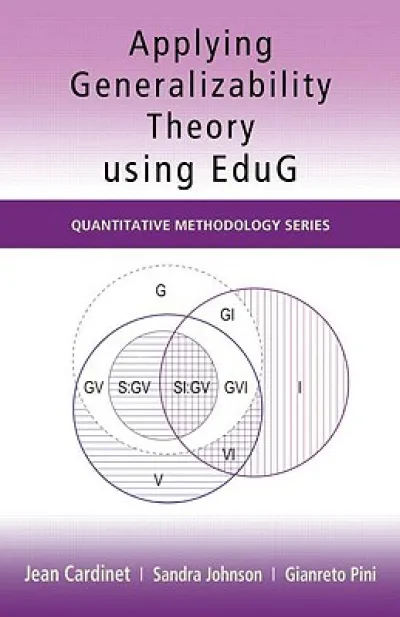
Applying Generalizability Theory using EduG

By: (Author) Gianreto Pini , (Author) Jean Cardinet , (Author) Sandra Johnson

Werezi Extended Catalogue
Delivery in 34 days

Ksh 7,550.00

Format: Paperback / Softback

ISBN-10: 1848728298

ISBN-13: 9781848728295

Series: Quantitative Methodology Series

Publisher: Taylor & Francis Ltd

Imprint: Routledge

Country of Manufacture: GB

Country of Publication: GB

Publication Date: Oct 28th, 2009

Print length: 234 Pages

Weight: 336 grams

Dimensions (height x width x thickness): 22.80 x 15.20 x 1.30 cms

Product Classification: Psychological testing & measurement

Choose your Location

Shipping & Delivery

Door Delivery

Delivery fee

Delivery in 34 days

  • Description

  • Reviews

Generalizability Theory (G theory) conceptually models the way in which the reliability of measurement is ascertained. Intended to help improve measurement and data collection methods in the behavioral, social, and medical sciences, this book demonstrates an expanded and accessible use of G Theory.

Intended to help improve measurement and data collection methods in the behavioral, social, and medical sciences, this book demonstrates an expanded and accessible use of Generalizability Theory (G theory). G theory conceptually models the way in which the reliability of measurement is ascertained. Sources of score variation are identified as potential contributors to measurement error and taken into account accordingly. The authors demonstrate the powerful potential of G theory by showing how to improve the quality of any kind of measurement, regardless of the discipline.

Readers will appreciate the conversational style used to present a comprehensive review of G theory and its application using the freeware EduG. To maximize understanding the authors illustrate all fundamental principles with concrete examples from different fields and contexts. Annotated applications lead students through the main concepts of G theory, while illustrating both the use of EduG and interpretation of its output. Formulas are avoided wherever possible. Exercises with data sets available on the Psychology Press website allow readers to carry out their own analyses to reinforce understanding.

Brief overviews of analysis of variance, estimation, and the statistical error model are provided for review. The procedures involved in carrying out a generalizability study using EduG follow, as well as guidance in the interpretation of results. Real-world applications of G theory to the assessment of depression, managerial ability, attitudes, and writing and mathematical skills are then presented. Next, annotated exercises provide an opportunity for readers to use EduG and interpret its results. The book concludes with a review of the development of G theory and possible new directions of application. Finally, for those with a strong statistical background, the appendixes provide the formulas used by EduG.


Ideal as a supplement for courses on measurement theory and/or generalizability theory taught in departments of psychology, education, medicine, and the social sciences, this text will also appeal to researchers from a variety of fields interested in learning how to apply G theory to their studies.


Get Applying Generalizability Theory using EduG by at the best price and quality guranteed only at Werezi Africa largest book ecommerce store. The book was published by Taylor & Francis Ltd and it has pages. Enjoy Shopping Best Offers & Deals on books Online from Werezi - Receive at your doorstep - Fast Delivery - Secure mode of Payment

Customer Reviews

Based on 0 reviews

Mind, Body, & Spirit