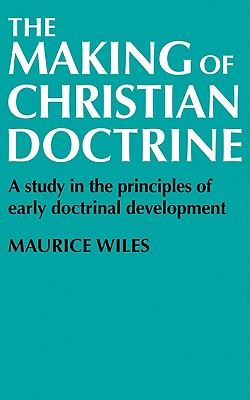
Archetypal Heresy : Arianism Through the Centuries
Book Details
Format
Paperback / softback
ISBN-10
0199245916
ISBN-13
9780199245918
Publisher
Oxford University Press
Imprint
Oxford University Press
Country of Manufacture
GB
Country of Publication
GB
Publication Date
Apr 12th, 2001
Print length
214 Pages
Weight
282 grams
Dimensions
21.60 x 13.70 x 1.40 cms
Product Classification:
NoneChristian theologyHistory of ideasHistory of ideasHistory of ideasChristianity
KSh 9,400.00
Currently unavailable
0 in stock
Delivery Location
Delivery fee: Select location
Secure
Quality
Fast
Traces the history of how Arianism has been viewed in later Christian thought, particularly where scholars or religious groups have adopted broadly Arian views. This work also deals with how and why their beliefs took this form, and why this approach disappeared again around the end of the century.
Arianism has always been regarded as the archetypal heresy. It did affirm the divinity of Christ as the Son of God, but, unlike orthodoxy, it regarded the divinity as secondary and inferior to that of the Father, the one supreme God. Recently many scholars have presented a more positive view of the religious intentions of Arianism than has been customary in the past. Yet the Nicene Creed, which was designed explicitly to outlaw Arianism, remains one of the primary expressions of Christian orthodoxy. Maurice Wiles traces the history of how Arianism has been viewed in later Christian thought, particularly where scholars or religious groups have adopted broadly Arian views. The main example of a re-emergence of Arian ideas is among the leaders of new scientific Englightenment in the early eighteenth century, especially Sir Isaac Newton and his disciples, William Whiston and Samuel Clarke. The longest section of the book deals with how and why their beliefs took this form, and why this approach disappeared again around the end of the century. A final section considers the interaction of belief and cricital judgement in British Arian scholarship during the nineteenth and twentieth centuries.
Get Archetypal Heresy by Maurice Wiles at the best price and quality guaranteed only at Werezi Africa's largest book ecommerce store. The book was published by Oxford University Press and it has 214 pages.
Customers Who Bought This Also Bought
Montanism
KSh 17,800.00

Trump Vs the Beast
KSh 3,600.00

Irenaeus on the Christian Faith
KSh 4,950.00

Slandering the Sacred – Blasphemy Law and Religious Affect in Colonial India
KSh 4,650.00
Heretics
KSh 3,950.00
Ancoratus und Panarion haer. 1-33
KSh 29,700.00

Leaving Islam, Ex-Muslims and Zemiology
KSh 30,950.00

Leaving Islam, Ex-Muslims and Zemiology
KSh 8,800.00
Julian's Against the Galileans
KSh 5,400.00
Freedom of Religion, Apostasy and Islam
KSh 30,950.00
Classifying Christians
KSh 14,400.00
The Pursuit of Heresy
KSh 8,100.00