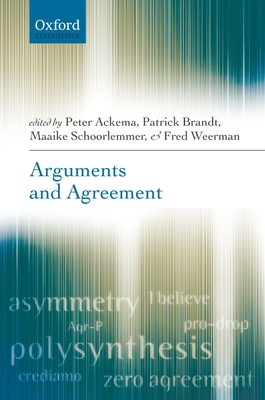
Arguments and Agreement
Book Details
Format
Hardback
ISBN-10
019928573X
ISBN-13
9780199285730
Publisher
Oxford University Press
Imprint
Oxford University Press
Country of Manufacture
GB
Country of Publication
GB
Publication Date
Sep 28th, 2006
Print length
358 Pages
Weight
660 grams
Dimensions
24.00 x 16.40 x 2.70 cms
Product Classification:
Grammar, syntax & morphologyGrammar, syntax and morphology
KSh 27,800.00
Currently unavailable
0 in stock
Delivery Location
Delivery fee: Select location
Secure
Quality
Fast
Explores the role of agreement morphology in the morphosyntactic realization of a verb's arguments. This book is of interest to linguists at graduate level and above concerned with morphosyntactic theory, typology, and the interactions of syntax and morphology in different languages.
This book brings together new work by leading syntactic theorists from the USA and Europe on a central aspect of syntactic and morphological theory: it explores the role of agreement morphology in the morphosyntactic realization of a verb''s arguments. The authors examine the differences and parallels between nonconfigurational, pronominal- agreement languages; configurational languages which allow pronoun drop (for example, "Is coming" for "He is coming"); languages that allow pronoun drop in particular constructions only; and languages which always require overt syntactic determiner phrases as arguments. The book considers whether the morphological properties of agreement play a role in determining which of these types a language belongs to and how far languages differ with respect to the argumental status of their agreement and syntactic determiner phrases. The authors explore these and related issues and problems in the context of a wide range of languages. Their book will interest linguists at graduate level and above concerned with morphosyntactic theory, linguistic typology, and the interactions of syntax and morphology in different languages.
Get Arguments and Agreement by Fred Weerman, Maaike Schoorlemmer at the best price and quality guaranteed only at Werezi Africa's largest book ecommerce store. The book was published by Oxford University Press and it has 358 pages.
Customers Who Bought This Also Bought

Essential German Grammar
KSh 8,400.00
Analysing Sentences
KSh 7,400.00

Diachronic divergences in West Iberian languages
KSh 19,250.00

A Grammar of Teotitlan del Valle Zapotec
KSh 28,100.00

Argument Legitimacy Principles
KSh 30,950.00

A Semantic Grammar of Kiowa
KSh 20,450.00

Exploring Passivization
KSh 18,000.00

A Comparative Analysis of Classifier-Noun Structures in Chinese and English
KSh 32,000.00

Construction Grammar and Sociolinguistic Theory
KSh 20,450.00
Control as Movement
KSh 19,600.00
A Historical Syntax of English
KSh 19,800.00
Formulaic Language and the Lexicon
KSh 19,600.00