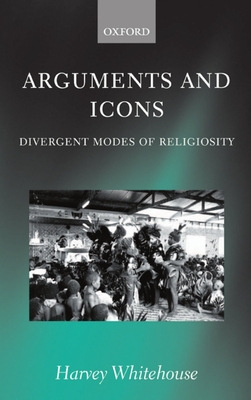
Arguments and Icons : Divergent Modes of Religiosity
Book Details
Format
Paperback / softback
ISBN-10
0198234155
ISBN-13
9780198234159
Publisher
Oxford University Press
Imprint
Oxford University Press
Country of Manufacture
GB
Country of Publication
GB
Publication Date
Jun 1st, 2000
Print length
216 Pages
Weight
278 grams
Dimensions
21.80 x 13.90 x 1.20 cms
Product Classification:
Regional studiesRegional / International studiesChristianityCultural studiesSocial groups: religious groups and communitiesCultural studiesReligious groups: social & cultural aspectsAnthropologySocial & cultural anthropology, ethnographySocial and cultural anthropologyPhysical anthropologyChristianity
KSh 13,350.00
Currently unavailable
0 in stock
Delivery Location
Delivery fee: Select location
Secure
Quality
Fast
Through a close examination of four Melanesian religious traditions, Whitehouse identifies a set of recurrent interconnections between styles of religious transmission, systems of memory, and patterns of political association. He argues that these interconnections may shed light on a variety of general problems in history, archaeology, and social theory.
Why do initiations in Papua New Guinea often subject novices to violence and terror? Why do some cargo cults lead to regional unity and others to regional divisions? How have features of cognitive processing in missionary Christianity contributed to new forms of identity among Melanesians? The theory of `modes of religiosity'' which Whitehouse here develops answers these and a range of other questions about Melanesia with reference to a set of interconnections between styles of religious transmission, systems of memory, and patterns of political association. Although building his argument on detailed Melanesian ethnography, Whitehouse goes on to suggest that the theory of modes of religiosity may have wider applicability. Thus, in the final two chapters of this book, he explores such diverse topics as the spread of Reformed Christianity in sixteenth-century Europe, the interpretation of Upper Palaeolithic cave art, the genesis of tribal warfare, and the impact of literacy on social transmission and organization.
Get Arguments and Icons by Harvey Whitehouse at the best price and quality guaranteed only at Werezi Africa's largest book ecommerce store. The book was published by Oxford University Press and it has 216 pages.
Customers Who Bought This Also Bought
Orientalism
KSh 2,350.00
The Collected Essays of Ralph Ellison
KSh 3,600.00

Jorge Amado
KSh 8,850.00

The Guatemala Reader
KSh 4,950.00
Jorge Amado
KSh 30,950.00

Demoralization of Teachers
KSh 15,450.00
Except for Palestine
KSh 3,400.00

A Grammar of Mangghuer
KSh 10,050.00

Grammar of Mangghuer
KSh 30,950.00

Routledge Handbook on China-Middle East Relations
KSh 9,250.00
Except for Palestine
KSh 3,400.00

The Israeli-Palestinian Conflict
KSh 9,200.00