
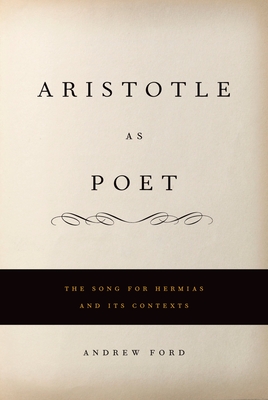
Aristotle as Poet : The Song for Hermias and Its Contexts
Book Details
Format
Hardback
ISBN-10
0199733295
ISBN-13
9780199733293
Publisher
Oxford University Press Inc
Imprint
Oxford University Press Inc
Country of Manufacture
US
Country of Publication
GB
Publication Date
May 12th, 2011
Print length
264 Pages
Weight
404 grams
Dimensions
21.70 x 16.30 x 2.30 cms
KSh 14,250.00
Currently unavailable
0 in stock
Delivery Location
Delivery fee: Select location
Secure
Quality
Fast
This comprehensive and in-depth examination of Aristotle's poetry is focused on his ode for Hermias of Atarneus. The song's relation to earlier poetry is illustrated with unprecedented thoroughness and the remarkable story of its reception is studied in the context of fourth-century politics, religious history, and literary theory.
Aristotle is known as a philosopher and as a theorist of poetry, but he was also a composer of songs and verse. This is the first comprehensive study of Aristotle''s poetic activity, interpreting his remaining fragments in relation to the earlier poetic tradition and to the literary culture of his time. Its centerpiece is a study of the single complete ode to survive, a song commemorating Hermias of Atarneus, Aristotle''s father-in-law and patron in the 340''s BCE. This remarkable text is said to have embroiled the philosopher in charges of impiety and so is studied both from a literary perspective and in its political and religious contexts.Aristotle''s literary antecedents are studied with an unprecedented fullness that considers the entire range of Greek poetic forms, including poems by Sappho, Pindar, and Sophocles, and prose texts as well. Apart from its interest as a complex and subtle poem, the Song for Hermias is noteworthy as one of the first Greek lyrics for which we have substantial and early evidence for how and where it was composed, performed, and received. It thus affords an opportunity to reconstruct how Greek lyric texts functioned as performance pieces and how they circulated and were preserved. The book argues that Greek lyric poems profit from being read as scripts for performances that both shaped and were shaped by the social occasions in which they were performed. The result is a thorough and wide-ranging study of a complex and fascinating literary document that gives a fuller view of literature in the late classical age.
Get Aristotle as Poet by Andrew L. Ford at the best price and quality guaranteed only at Werezi Africa's largest book ecommerce store. The book was published by Oxford University Press Inc and it has 264 pages.
Customers Who Bought This Also Bought
The Odyssey
KSh 1,800.00
The Odyssey
KSh 1,600.00
The Divine Comedy
KSh 2,350.00
Annals
KSh 2,350.00
Classical Literary Criticism
KSh 2,350.00
Great Dialogues of Plato
KSh 1,450.00
The Divine Comedy
KSh 2,700.00
The Iliad
KSh 1,800.00

The Masnavi, Book Six
KSh 2,000.00

The Masnavi, Book Five
KSh 1,800.00
Chaucer's Pardoner and Gender Theory
KSh 8,100.00
Classical Literary Criticism
KSh 1,800.00
