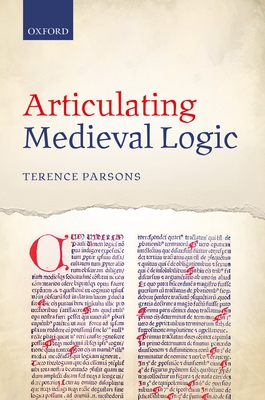
Articulating Medieval Logic
Book Details
Format
Hardback
ISBN-10
0199688842
ISBN-13
9780199688845
Publisher
Oxford University Press
Imprint
Oxford University Press
Country of Manufacture
GB
Country of Publication
GB
Publication Date
Feb 27th, 2014
Print length
346 Pages
Weight
676 grams
Dimensions
16.00 x 23.90 x 2.40 cms
Product Classification:
Western philosophy: Medieval & Renaissance, c 500 to c 1600Philosophy: logicHistory of ideas
KSh 21,000.00
Temporarily out of stock, due soon
0 in stock
Delivery Location
Delivery fee: Select location
Secure
Quality
Fast
Terence Parsons presents a new study of the development and continuing value of medieval logic, which expanded Aristotle's basic principles of logic in important ways. Parsons argues that the resulting system is as rich as contemporary first-order symbolic logic.
Terence Parsons presents a new study of the development and logical complexity of medieval logic. Basic principles of logic were used by Aristotle to prove conversion principles and reduce syllogisms. Medieval logicians expanded Aristotle''s notation in several ways, such as quantifying predicate terms, as in ''No donkey is every animal'', and allowing singular terms to appear in predicate position, as in ''Not every donkey is Brownie''; with the enlarged notation come additional logical principles. The resulting system of logic is able to deal with relational expressions, as in De Morgan''s puzzles about heads of horses. A crucial issue is a mechanism for dealing with anaphoric pronouns, as in ''Every woman loves her mother''. Parsons illuminates the ways in which medieval logic is as rich as contemporary first-order symbolic logic, though its full potential was not envisaged at the time. Along the way, he provides a detailed exposition and examination of the theory of modes of common personal supposition, and the useful principles of logic included with it. An appendix discusses the artificial signs introduced in the fifteenth century to alter quantifier scope.
Get Articulating Medieval Logic by Terence Parsons at the best price and quality guaranteed only at Werezi Africa's largest book ecommerce store. The book was published by Oxford University Press and it has 346 pages.
Customers Who Bought This Also Bought

The Life Of The Mind
KSh 3,950.00
Augustine the African
KSh 4,500.00

Essential Galileo
KSh 2,900.00

Ockham: Philosophical Writings
KSh 3,800.00

Duns Scotus: Philosophical Writings
KSh 4,150.00

Perception As a Capacity for Knowledge
KSh 2,150.00

Reading Illegitimacy in Early Iberian Literature
KSh 8,100.00
Thomas Aquinas
KSh 7,700.00
Moses and Abraham Maimonides
KSh 14,050.00
The Philosopher in Early Modern Europe
KSh 7,950.00

Die japanischsprachige Hegel-Rezeption von 1878 bis 2001
KSh 19,900.00
The One Mediator
KSh 10,600.00