
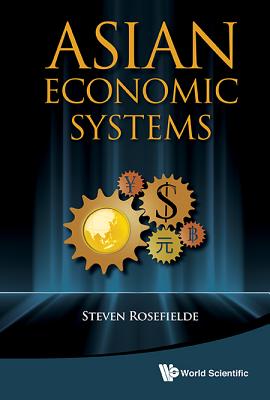
Asian Economic Systems
Book Details
Delivery Location
Delivery fee: Select location
Asian Economic Systems provides readers with a crisp analytic framework, concepts and narrative highlighting contemporary Asia's systemic diversity. The framework facilitates insightful comparison with the western neoclassical ideal. This method allows students to easily appreciate the special virtues of various Asian economic systems, and compare them with those offered in the west. This objective is buttressed with background material on Asian economic history where appropriate, together with basic data on Asian and global economic performance to help students integrate concepts with experience.
The approach provides an objective platform for discussing Asia's place and future in the new global order. It makes it clear that there is no universally best economic system. There are a variety of good systems and nations should choose the system that best suits their cultural heritage, values and aspirations.
The approach informs discussions about the wisdom of forming regional free trade zones, economic communities (like ASEAN), and unions (analogous to the European Union), as well as forging a one-world system of economic governance.
Also, Asian Economic Systems has a secondary goal. It provides the tools needed for training students in how to apply microeconomic, macroeconomic and financial principles to practical issues of systems and policies.
The book focuses on East and Southeast Asia. The term Asia is used as a shorthand for the cultural region dominated historically by Confucian kinship networks, Japanese communalism and Theravada Buddhism, and more recently by Marxist–Leninist communism. It excludes the Middle East, Central Asia, the Himalayan states, South Asia, Malaysia, Indonesia, the Philippines, Russia and America's Asia Pacific possessions.
The book identifies and elaborates four rival market systems in contemporary Asia each with its own distinctive performance characteristics, potentials and humanist properties: (1) communist (China, Vietnam, Laos and Cambodia), (2) Confucian (Taiwan, Singapore, Hong Kong, and South Korea), (3) communal (Japan), and (4) Theravada Buddhist (Thailand and Sri Lanka). Their comparative merit is partly obscured by differences in stages of economic development, epochal, and conjunctural factors, but their special positive and negative attributes are unmistakable, and are compared with North Korea's communist command system which is the region's fifth core alternative to democratic free enterprise.
Get Asian Economic Systems by Steven Rosefielde at the best price and quality guaranteed only at Werezi Africa's largest book ecommerce store. The book was published by World Scientific Publishing Co Pte Ltd and it has 296 pages.
Customers Who Bought This Also Bought

The Road to Serfdom
KSh 3,600.00
Portfolios of the Poor – How the World`s Poor Live on $2 a Day
KSh 5,400.00

Radical Intimacy
KSh 2,900.00
Discrimination and Disparities
KSh 5,400.00

Entrepreneurial State
KSh 2,350.00

Capitalism
KSh 9,000.00

Capital & Ideology
KSh 3,050.00

The Power of Creative Destruction – Economic Upheaval and the Wealth of Nations
KSh 3,250.00

Capitalism – The Story behind the Word
KSh 2,500.00

Deficit Myth
KSh 2,350.00

Vulture Capitalism
KSh 2,000.00

Value of Everything
KSh 2,350.00
More by Steven Rosefielde

Russo-Ukrainian War
KSh 19,800.00

Harris Versus Trump: America's Existential Futures
KSh 4,500.00
Democracy and Its Elected Enemies
KSh 18,900.00

Harris Versus Trump
KSh 9,900.00
Transformation and Crisis in Central and Eastern Europe
KSh 8,800.00

Beleaguered Superpower
KSh 16,200.00

Beleaguered Superpower
KSh 5,400.00

The Kremlin Strikes Back
KSh 5,500.00

Populists And Progressives: The New Forces In American Politics
KSh 11,700.00

China?s Market Communism
KSh 30,950.00

Russia in the 21st Century
KSh 10,100.00

Red Holocaust
KSh 37,800.00
