
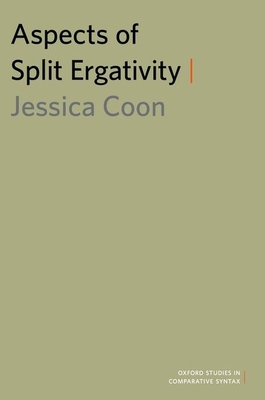
Aspects of Split Ergativity
by
Jessica Coon
Book Details
Format
Paperback / softback
Book Series
Oxford Studies in Comparative Syntax
ISBN-10
019985873X
ISBN-13
9780199858736
Publisher
Oxford University Press Inc
Imprint
Oxford University Press Inc
Country of Manufacture
US
Country of Publication
GB
Publication Date
Sep 19th, 2013
Print length
290 Pages
Weight
378 grams
Dimensions
23.30 x 15.30 x 1.90 cms
Product Classification:
PsycholinguisticsHistorical & comparative linguisticsGrammar, syntax & morphology
KSh 7,750.00
Currently unavailable
0 in stock
Delivery Location
Delivery fee: Select location
Secure
Quality
Fast
Aspects of Split Ergativity argues that aspect-based split ergativity does not mark a split in how Case is assigned, but rather, a split in sentence structure.
In languages with aspect-based split ergativity, one portion of the grammar follows an ergative pattern, while another shows a "split." In this book, Jessica Coon argues that aspectual split ergativity does not mark a split in how case is assigned, but rather, a split in sentence structure. Specifically, the contexts in which we find the appearance of a nonergative pattern in an otherwise ergative language involve added structure -- a disassociation between the syntactic predicate and the stem carrying the lexical verb stem. This proposal builds on the proposal of Basque split ergativity in Laka 2006, and extends it to other languages.The book begins with an analysis of split person marking patterns in Chol, a Mayan language of southern Mexico. Here appearance of split ergativity follows naturally from the fact that the progressive and the imperfective morphemes are verbs, while the perfective morpheme is not. The fact that the nonperfective morphemes are verbs, combined with independent properties of Chol grammar, results in the appearance of a split.In aspectual splits, ergativity is always retained in the perfective aspect. This book further surveys aspectual splits in a variety of unrelated languages and offers an explanation for this universal directionality of split ergativity. Following Laka''s (2006) proposal for Basque, Coon proposes that the cross-linguistic tendency for imperfective aspects to pattern with locative constructions is responsible for the biclausality which causes the appearance of a nonergative pattern. Building on Demirdache and Uribe-Etxebarria''s (2000) prepositional account of spatiotemporal relations, Coon proposes that the perfective is never periphrastic - and thus never involves a split - because there is no preposition in natural language that correctly captures the relation of the assertion time to the event time denoted by the perfective aspect.
Get Aspects of Split Ergativity by Jessica Coon at the best price and quality guaranteed only at Werezi Africa's largest book ecommerce store. The book was published by Oxford University Press Inc and it has 290 pages.
Customers Who Bought This Also Bought

The Perks of Being a Bookworm
KSh 4,500.00
Semiotics and the Philosophy of Language
KSh 3,400.00

Chinese Children''s Reading Acquisition
KSh 16,200.00

New Trends in Language Acquisition Within the Generative Perspective
KSh 21,600.00

Vocabulary Studies in First and Second Language Acquisition
KSh 18,000.00

Improving the Emotional Intelligence of Translators
KSh 10,800.00
Phonology and Language Use
KSh 18,900.00

Engaging Children in Applied Linguistics Research
KSh 17,100.00
Optimality Theory and Pragmatics
KSh 8,100.00

Meaning
KSh 1,800.00

Nonverbal Steps to the Origins of Language
KSh 7,900.00
Active Learning from Infancy to Childhood
KSh 21,600.00
More in This Genre
The Perks of Being a Bookworm
KSh 4,500.00
Semiotics and the Philosophy of Language
KSh 3,400.00
Chinese Children''s Reading Acquisition
KSh 16,200.00
New Trends in Language Acquisition Within the Generative Perspective
KSh 21,600.00
Vocabulary Studies in First and Second Language Acquisition
KSh 18,000.00
Improving the Emotional Intelligence of Translators
KSh 10,800.00
