
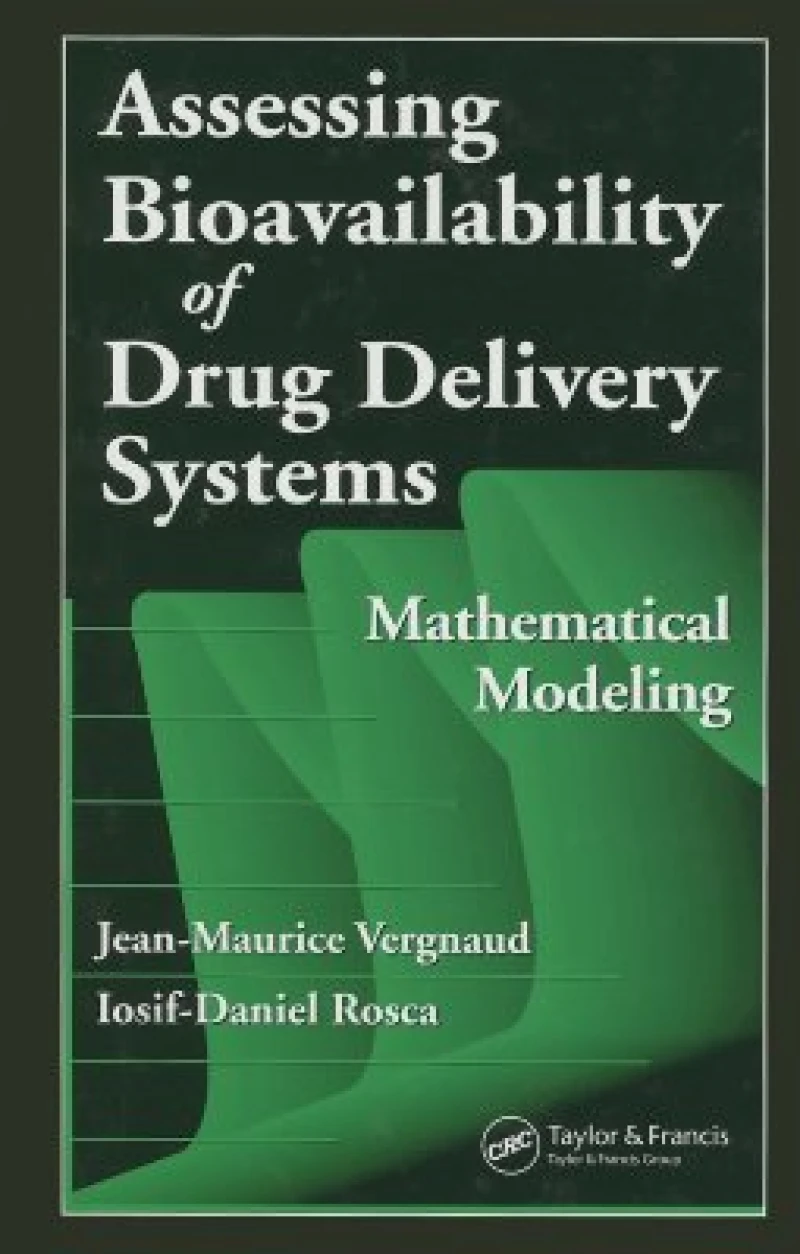
Assessing Bioavailablility of Drug Delivery Systems : Mathematical Modeling
Book Details
Format
Hardback or Cased Book
ISBN-10
0849330440
ISBN-13
9780849330445
Publisher
Taylor & Francis Inc
Imprint
CRC Press Inc
Country of Manufacture
GB
Country of Publication
GB
Publication Date
May 26th, 2005
Print length
244 Pages
Weight
476 grams
Product Classification:
PharmacologyApplied mathematicsBiology, life sciencesPharmaceutical technology
Ksh 42,300.00
Re-Printing
0 in stock
Delivery Location
Delivery fee: Select location
Secure
Quality
Fast
Exploring how to apply in vitro/in vivo correlations for controlled release dosage forms, this book elucidates this phenomena. It introduces mathematical modeling methods for calculating the profiles of plasma levels obtained with controlled release dosage forms and provides examples and case studies to illustrate the techniques employed.
Exploring how to apply in vitro/in vivo correlations for controlled release dosage forms, Bioavailability of Drug Delivery Systems: Mathematical Modeling clearly elucidates this complex phenomena and provides a guide for the respective mathematical modeling. The book introduces mathematical modeling methods for calculating the profiles of plasma levels obtained with controlled release dosage forms and provides examples and case studies to illustrate the techniques employed.
The author has considerable experience in investigating mathematical fundamentals that are related to pharmaco- and toxicokinetics, modified-release drug products, physiologic pharmacokinetics and statistical treatment in clinical situations. The mathematical models he has developed are particularly powerful because they account for such major parameters as the kinetics of drug release controlled by diffusion or by erosion, and the kinetics of absorption into and elimination out of the plasma. They are also able to solve the problem of determining the drug level in plasma as a result of patient non-compliance, incorrect dosage, and incorrect frequency and to determine the best dosage forms necessary for therapy.
Using master curves, the book highlights the inter-variability of the patients often expressed by different responses towards a drug. Thus, after evaluating a patient''s pharmacokinetic parameters, the dose can be adapted to the patient, with the expectation of decreasing the side effects for each patient. Using dimensionless numbers in repeated doses, either for the time or for the plasma drug concentration, makes the master curves useful for every drug, providing that its pharmacokinetics was linear. These master curves address clear information either to the patients or to the therapists in a didactic and easy way. The patients can see from first look the effects of non-compliance and therapists can see the dramatic effects of inter-variability of patients towards a drug.
Drug discovery and dosage forms have become an increasingly time-consuming and expensive process. The development of a single drug can leave behind more than 10 to 15 years of work. Discussing time and cost-effective methods as alternatives to conventional in vivo methods, the book helps you analyze and integrate in vitro/in vivo correlations and apply them to patient care and drug consultation situations.
The author has considerable experience in investigating mathematical fundamentals that are related to pharmaco- and toxicokinetics, modified-release drug products, physiologic pharmacokinetics and statistical treatment in clinical situations. The mathematical models he has developed are particularly powerful because they account for such major parameters as the kinetics of drug release controlled by diffusion or by erosion, and the kinetics of absorption into and elimination out of the plasma. They are also able to solve the problem of determining the drug level in plasma as a result of patient non-compliance, incorrect dosage, and incorrect frequency and to determine the best dosage forms necessary for therapy.
Using master curves, the book highlights the inter-variability of the patients often expressed by different responses towards a drug. Thus, after evaluating a patient''s pharmacokinetic parameters, the dose can be adapted to the patient, with the expectation of decreasing the side effects for each patient. Using dimensionless numbers in repeated doses, either for the time or for the plasma drug concentration, makes the master curves useful for every drug, providing that its pharmacokinetics was linear. These master curves address clear information either to the patients or to the therapists in a didactic and easy way. The patients can see from first look the effects of non-compliance and therapists can see the dramatic effects of inter-variability of patients towards a drug.
Drug discovery and dosage forms have become an increasingly time-consuming and expensive process. The development of a single drug can leave behind more than 10 to 15 years of work. Discussing time and cost-effective methods as alternatives to conventional in vivo methods, the book helps you analyze and integrate in vitro/in vivo correlations and apply them to patient care and drug consultation situations.
Get Assessing Bioavailablility of Drug Delivery Systems by at the best price and quality guaranteed only at Werezi Africa's largest book ecommerce store. The book was published by Taylor & Francis Inc and it has pages.

