
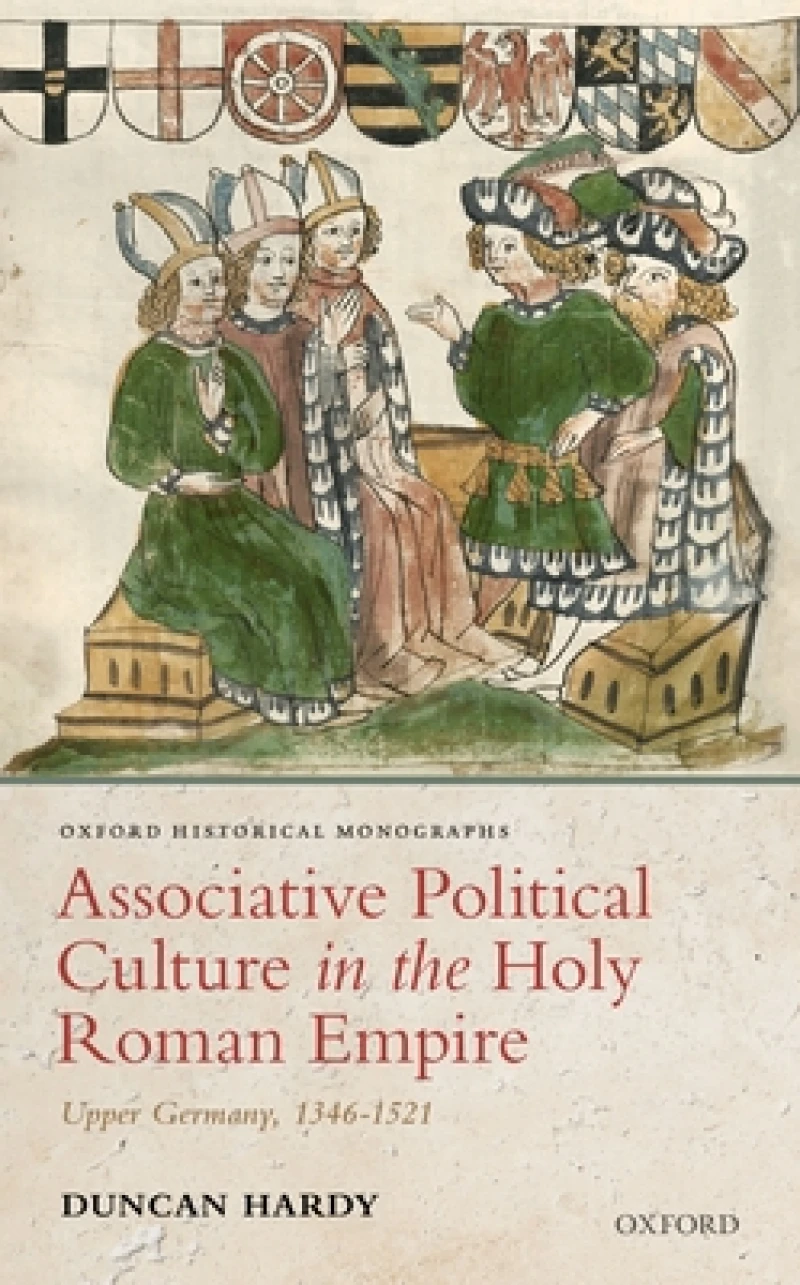
Associative Political Culture in the Holy Roman Empire : Upper Germany, 1346-1521
by
Duncan Hardy
Book Details
Format
Hardback or Cased Book
Book Series
Oxford Historical Monographs
ISBN-10
0198827253
ISBN-13
9780198827252
Publisher
Oxford University Press
Imprint
Oxford University Press
Country of Manufacture
GB
Country of Publication
GB
Publication Date
Sep 12th, 2018
Print length
322 Pages
Weight
524 grams
Dimensions
14.90 x 22.30 x 2.30 cms
Product Classification:
European historyMedieval historyPolitics & government
Ksh 23,100.00
Manufactured on Demand
0 in stock
Delivery Location
Delivery fee: Select location
Secure
Quality
Fast
Associative Political Culture in the Holy Roman Empire offers a new and more coherent exploration of the Holy Roman Empire, depicting it as a sprawling community of interdependent elites who interacted within the framework of a shared political culture.
What was the Holy Roman Empire in the fourteenth to sixteenth centuries? At the turning point between the medieval and early modern periods, this vast Central European polity was the continent''s most politically fragmented. The imperial monarchs were often weak and distant, while a diverse array of regional actors played an autonomous role in political life. The Empire''s obvious differences compared with more centralized European kingdoms have stimulated negative historical judgements and fraught debates, which have found expression in recent decades in the concepts of fractured ''territorial states'' and a disjointed ''imperial constitution''. Associative Political Culture in the Holy Roman Empire challenges these interpretations through a wide-ranging case study of Upper Germany -- the southern regions of modern-day Germany plus Alsace, Switzerland, and western Austria -- between 1346 and 1521. By examining the interactions of princes, prelates, nobles, and towns comparatively, Associative Political Culture in the Holy Roman Empire demonstrates that a range of actors and authorities shared the same toolkit of technologies, rituals, judicial systems, and concepts and configurations of government. Crucially, Upper German elites all participated in leagues, alliances, and other treaty-based associations. As frameworks for collective activity, associations were a vital means of enabling and regulating warfare, justice and arbitration, and even lordship and administration.On the basis of this evidence, Associative Political Culture in the Holy Roman Empire offers a new and more coherent depiction of the Holy Roman Empire as a sprawling community of interdependent elites who interacted within the framework of a shared political culture.
Get Associative Political Culture in the Holy Roman Empire by at the best price and quality guaranteed only at Werezi Africa's largest book ecommerce store. The book was published by Oxford University Press and it has pages.

