
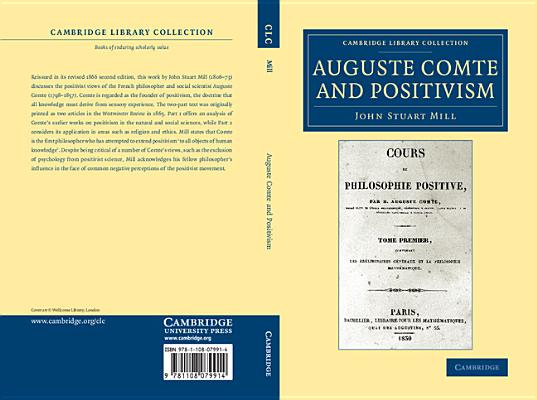
Auguste Comte and Positivism
Book Details
Format
Paperback / softback
Book Series
Cambridge Library Collection - Philosophy
ISBN-10
1108079911
ISBN-13
9781108079914
Publisher
Cambridge University Press
Imprint
Cambridge University Press
Country of Manufacture
GB
Country of Publication
GB
Publication Date
Jul 28th, 2016
Print length
208 Pages
Weight
29 grams
Dimensions
14.30 x 21.60 x 1.70 cms
Product Classification:
Western philosophy: c 1600 to c 1900Philosophical traditions and schools of thought
KSh 4,150.00
Currently unavailable
0 in stock
Delivery Location
Delivery fee: Select location
Secure
Quality
Fast
Reissued in its revised 1866 second edition, this is Mill's discussion of the positivist views of French philosopher and social scientist Auguste Comte (1798–1857). Mill analyses Comte's earlier works on positivism in the natural and social sciences, and then positivism's application in areas such as religion and ethics.
Reissued in its revised 1866 second edition, this work by John Stuart Mill (1806–73) discusses the positivist views of the French philosopher and social scientist Auguste Comte (1798–1857). Comte is regarded as the founder of positivism, the doctrine that all knowledge must derive from sensory experience. The two-part text was originally printed as two articles in the Westminster Review in 1865. Part 1 offers an analysis of Comte's earlier works on positivism in the natural and social sciences, while Part 2 considers its application in areas such as religion and ethics. Mill states that Comte is the first philosopher who has attempted to extend positivism 'to all objects of human knowledge'. Despite being critical of a number of Comte's views, such as the exclusion of psychology from positivist science, Mill acknowledges his fellow philosopher's influence in the face of common negative perceptions of the positivist movement.
Get Auguste Comte and Positivism by John Stuart Mill at the best price and quality guaranteed only at Werezi Africa's largest book ecommerce store. The book was published by Cambridge University Press and it has 208 pages.
Customers Who Bought This Also Bought

Why I Am so Clever
KSh 700.00

A Treatise of Human Nature
KSh 2,700.00

On the Genealogy of Morals
KSh 2,000.00
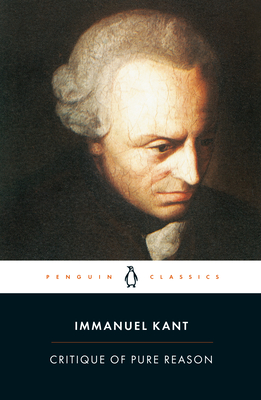
Critique of Pure Reason
KSh 3,400.00

Beyond Good and Evil
KSh 2,000.00

Either/Or
KSh 2,700.00

Great Ideas Fear and Trembling
KSh 1,450.00
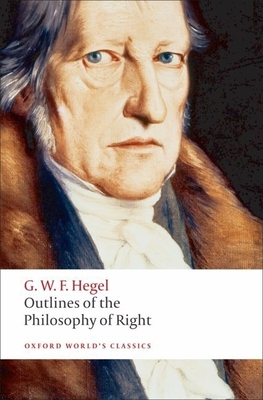
Outlines of the Philosophy of Right
KSh 2,500.00
Critique of Judgement
KSh 2,700.00

Prolegomena to Any Future Metaphysics
KSh 2,700.00

Kant – A Revolution in Thinking
KSh 4,500.00
An Answer to the Question: ''What is Enlightenment?''
KSh 1,450.00
More by John Stuart Mill

Classical Utilitarians
KSh 2,900.00

On Liberty
KSh 1,600.00

Utilitarianism
KSh 1,600.00

Three Essays on Religion
KSh 4,900.00

John Stuart Mill and the Idea of the University
KSh 6,550.00
Subjection of Women
KSh 2,350.00

On Liberty - Ed. Kahn
KSh 3,250.00

On Liberty
KSh 1,100.00

On Liberty
KSh 3,800.00

Three Essays on Religion
KSh 5,500.00

Liberale Gleichheit
KSh 19,100.00

Writings on Representative Government and Parliamentary Reform
KSh 7,000.00
