
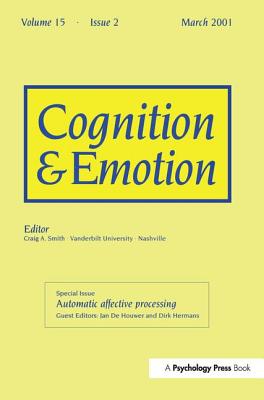
Automatic Affective Processing : A Special Issue of Cognition and Emotion
Book Details
Format
Paperback / softback
Book Series
Special Issues of Cognition and Emotion
ISBN-10
0863776469
ISBN-13
9780863776465
Publisher
Taylor & Francis Ltd
Imprint
Psychology Press Ltd
Country of Manufacture
GB
Country of Publication
GB
Publication Date
Feb 8th, 2001
Print length
138 Pages
Weight
260 grams
Product Classification:
Abnormal psychology
KSh 5,950.00
Currently unavailable
0 in stock
Delivery Location
Delivery fee: Select location
Secure
Quality
Fast
This special issue provides an overview of some of the paradigms that are available to study automatic affective processing and presents the knowledge about affective processing that has been gained in recent years.
The concepts ''affect'', ''valence'' and ''attitude'' are all fundamentally linked to the basic psychological dimension of good vs bad, positive vs negative, approach vs avoid. Affective processing refers to the act of determining the location of a stimulus on the affective dimension. Over the past few decades, scholars of emotion theory, social psychology, and learning psychology have put forward the hypothesis that affective processing does not depend on controlled cognitive processing. That is, they propose that organisms are able to determine whether a stimulus is good or bad without engaging in intentional, goal-directed, conscious, or capacity-demanding processing of the (evaluative attributes of the) stimulus. Rather, affective processing could occur automatically. Such automatic affective processing was believed to have an important impact on subsequent cognitive processing and behaviour.
These proposals led to a multitude of research. New paradigms were developed that allow one to study the conditions under which stimulus valence can be processed and efforts were directed at understanding how such affective processing influences subsequent cognitive processing and behaviour. The aim of this special issue is to provide an overview of some of (a) the paradigms that are available to study automatic affective processing, (b) the knowledge about affective processing that has been gained over the last years, and (c) the issues and questions that are currently being addressed and that will most likely dominate the research in years to come.
These proposals led to a multitude of research. New paradigms were developed that allow one to study the conditions under which stimulus valence can be processed and efforts were directed at understanding how such affective processing influences subsequent cognitive processing and behaviour. The aim of this special issue is to provide an overview of some of (a) the paradigms that are available to study automatic affective processing, (b) the knowledge about affective processing that has been gained over the last years, and (c) the issues and questions that are currently being addressed and that will most likely dominate the research in years to come.
Get Automatic Affective Processing by Dirk Hermans at the best price and quality guaranteed only at Werezi Africa's largest book ecommerce store. The book was published by Taylor & Francis Ltd and it has 138 pages.
Customers Who Bought This Also Bought

Silent Patient
KSh 2,000.00
Align Your Mind
KSh 3,050.00

Cry of Pain
KSh 3,050.00

The Anatomy of Melancholy
KSh 4,950.00

Outsmart Anxiety
KSh 4,700.00

Book of Books
KSh 2,350.00

Brain Boosting Food for Women with ADHD
KSh 1,450.00

Understanding and Taking Control of Menopausal Symptoms
KSh 30,950.00

Moral Injury and a First World War Chaplain
KSh 5,400.00

Understanding and Taking Control of Menopausal Symptoms
KSh 4,700.00
Deconstructing Anxiety
KSh 5,750.00

Re-Thinking Eating Disorders
KSh 7,000.00
