
Cart 0
Automating Inequality
Click to zoom

Share this book

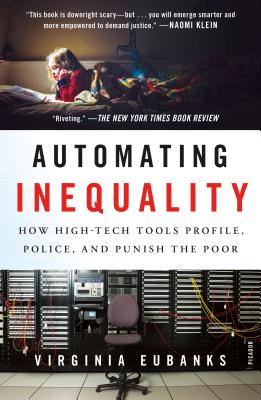
Automating Inequality : How High-Tech Tools Profile, Police, and Punish the Poor

Book Details

Format Paperback / Softback
ISBN-10 1250215781
ISBN-13 9781250215789
Publisher St Martins Pr
Imprint Picador USA
Country of Manufacture GB
Country of Publication GB
Publication Date Aug 6th, 2019
Print length 271 Pages
Weight 258 grams
Dimensions 13.70 x 20.90 x 2.10 cms
Product Classification: Poverty & unemployment
Ksh 3,600.00
Werezi Extended Catalogue Delivery in 14 days 2 copies in stock

Delivery Location

Delivery fee: Select location

Delivery in 14 days

Secure
Quality
Fast

WINNER: The 2019 Lillian Smith Book Award, 2018 McGannon Center Book Prize, and shortlisted for the Goddard Riverside Stephan Russo Book Prize for Social Justice

Astra Taylor, author of The People's Platform: "The single most important book about technology you will read this year."

Dorothy Roberts, author of Killing the Black Body: "A must-read."


A powerful investigative look at data-based discrimination?and how technology affects civil and human rights and economic equity

The State of Indiana denies one million applications for healthcare, foodstamps and cash benefits in three years because a new computer system interprets any mistake as ?failure to cooperate.? In Los Angeles, an algorithm calculates the comparative vulnerability of tens of thousands of homeless people in order to prioritize them for an inadequate pool of housing resources. In Pittsburgh, a child welfare agency uses a statistical model to try to predict which children might be future victims of abuse or neglect.

Since the dawn of the digital age, decision-making in finance, employment, politics, health and human services has undergone revolutionary change. Today, automated systems rather than humans control which neighborhoods get policed, which families attain needed resources, and who is investigated for fraud. While we all live under this new regime of data, the most invasive and punitive systems are aimed at the poor.

In Automating Inequality, Virginia Eubanks systematically investigates the impacts of data mining, policy algorithms, and predictive risk models on poor and working-class people in America. The book is full of heart-wrenching and eye-opening stories, from a woman in Indiana whose benefits are literally cut off as she lays dying to a family in Pennsylvania in daily fear of losing their daughter because they fit a certain statistical profile.

The U.S. has always used its most cutting-edge science and technology to contain, investigate, discipline and punish the destitute. Like the county poorhouse and scientific charity before them, digital tracking and automated decision-making hide poverty from the middle-class public and give the nation the ethical distance it needs to make inhumane choices: which families get food and which starve, who has housing and who remains homeless, and which families are broken up by the state. In the process, they weaken democracy and betray our most cherished national values.

This deeply researched and passionate book could not be more timely.

WINNER: The 2019 Lillian Smith Book Award, 2018 McGannon Center Book Prize, and shortlisted for the Goddard Riverside Stephan Russo Book Prize for Social Justice

Astra Taylor, author of The People''s Platform: "The single most important book about technology you will read this year."

Dorothy Roberts, author of Killing the Black Body: "A must-read."


A powerful investigative look at data-based discrimination?and how technology affects civil and human rights and economic equity

The State of Indiana denies one million applications for healthcare, foodstamps and cash benefits in three years—because a new computer system interprets any mistake as “failure to cooperate.” In Los Angeles, an algorithm calculates the comparative vulnerability of tens of thousands of homeless people in order to prioritize them for an inadequate pool of housing resources. In Pittsburgh, a child welfare agency uses a statistical model to try to predict which children might be future victims of abuse or neglect.

Since the dawn of the digital age, decision-making in finance, employment, politics, health and human services has undergone revolutionary change. Today, automated systems—rather than humans—control which neighborhoods get policed, which families attain needed resources, and who is investigated for fraud. While we all live under this new regime of data, the most invasive and punitive systems are aimed at the poor.

In Automating Inequality, Virginia Eubanks systematically investigates the impacts of data mining, policy algorithms, and predictive risk models on poor and working-class people in America. The book is full of heart-wrenching and eye-opening stories, from a woman in Indiana whose benefits are literally cut off as she lays dying to a family in Pennsylvania in daily fear of losing their daughter because they fit a certain statistical profile.

The U.S. has always used its most cutting-edge science and technology to contain, investigate, discipline and punish the destitute. Like the county poorhouse and scientific charity before them, digital tracking and automated decision-making hide poverty from the middle-class public and give the nation the ethical distance it needs to make inhumane choices: which families get food and which starve, who has housing and who remains homeless, and which families are broken up by the state. In the process, they weaken democracy and betray our most cherished national values.

This deeply researched and passionate book could not be more timely.


Get Automating Inequality by at the best price and quality guaranteed only at Werezi Africa's largest book ecommerce store. The book was published by St Martins Pr and it has pages.

Mind, Body, & Spirit

Price

Ksh 3,600.00

Shopping Cart

Africa largest book store

Sub Total:
Ebooks

Digital Library
Coming Soon

Our digital collection is currently being curated to ensure the best possible reading experience on Werezi. We'll be launching our Ebooks platform shortly.
