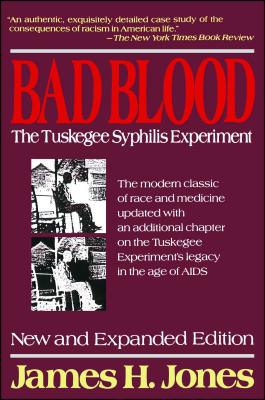
Bad Blood
Book Details
Format
Paperback / softback
ISBN-10
0029166764
ISBN-13
9780029166765
Publisher
Simon & Schuster
Imprint
The Free Press
Country of Manufacture
GB
Country of Publication
GB
Publication Date
Dec 5th, 1992
Print length
336 Pages
Weight
400 grams
Dimensions
23.30 x 15.70 x 2.60 cms
KSh 3,600.00
Publisher Out of Stock
0 in stock
Delivery Location
Delivery fee: Select location
Secure
Quality
Fast
Traces the evolution of medical ethics and the nature of decision making in bureaucracies and aims to show that the Tuskagee study - in which 400 black men known to be infected with syphilis were not treated - was not an aberration, but a result of race relations and medical practice in the US.
From 1932 to 1972, the United States Public Health Service conducted a non-therapeutic experiment involving over 400 black male sharecroppers infected with syphilis. The Tuskegee Study had nothing to do with treatment. Its purpose was to trace the spontaneous evolution of the disease in order to learn how syphilis affected black subjects.
From 1932 to 1972, the United States Public Health Service conducted a non-therapeutic experiment involving over 400 black male sharecroppers infected with syphilis. The Tuskegee Study had nothing to do with treatment. Its purpose was to trace the spontaneous evolution of the disease in order to learn how syphilis affected black subjects.
The men were not told they had syphilis; they were not warned about what the disease might do to them; and, with the exception of a smattering of medication during the first few months, they were not given health care. Instead of the powerful drugs they required, they were given aspirin for their aches and pains. Health officials systematically deceived the men into believing they were patients in a government study of “bad blood”, a catch-all phrase black sharecroppers used to describe a host of illnesses. At the end of this 40 year deathwatch, more than 100 men had died from syphilis or related complications.
“Bad Blood” provides compelling answers to the question of how such a tragedy could have been allowed to occur. Tracing the evolution of medical ethics and the nature of decision making in bureaucracies, Jones attempted to show that the Tuskegee Study was not, in fact, an aberration, but a logical outgrowth of race relations and medical practice in the United States.
Now, in this revised edition of “Bad Blood”, Jones traces the tragic consequences of the Tuskegee Study over the last decade. A new introduction explains why the Tuskegee Study has become a symbol of black oppression and a metaphor for medical neglect, inspiring a prize-winning play, a Nova special, and a motion picture. A new concluding chapter shows how the black community''s wide-spread anger and distrust caused by the Tuskegee Study has hampered efforts by health officials to combat AIDS in the black community. “Bad Blood” was nominated for the Pulitzer Prize and was one of the “N.Y. Times” 12 best books of the year.
From 1932 to 1972, the United States Public Health Service conducted a non-therapeutic experiment involving over 400 black male sharecroppers infected with syphilis. The Tuskegee Study had nothing to do with treatment. Its purpose was to trace the spontaneous evolution of the disease in order to learn how syphilis affected black subjects.
The men were not told they had syphilis; they were not warned about what the disease might do to them; and, with the exception of a smattering of medication during the first few months, they were not given health care. Instead of the powerful drugs they required, they were given aspirin for their aches and pains. Health officials systematically deceived the men into believing they were patients in a government study of “bad blood”, a catch-all phrase black sharecroppers used to describe a host of illnesses. At the end of this 40 year deathwatch, more than 100 men had died from syphilis or related complications.
“Bad Blood” provides compelling answers to the question of how such a tragedy could have been allowed to occur. Tracing the evolution of medical ethics and the nature of decision making in bureaucracies, Jones attempted to show that the Tuskegee Study was not, in fact, an aberration, but a logical outgrowth of race relations and medical practice in the United States.
Now, in this revised edition of “Bad Blood”, Jones traces the tragic consequences of the Tuskegee Study over the last decade. A new introduction explains why the Tuskegee Study has become a symbol of black oppression and a metaphor for medical neglect, inspiring a prize-winning play, a Nova special, and a motion picture. A new concluding chapter shows how the black community''s wide-spread anger and distrust caused by the Tuskegee Study has hampered efforts by health officials to combat AIDS in the black community. “Bad Blood” was nominated for the Pulitzer Prize and was one of the “N.Y. Times” 12 best books of the year.
Get Bad Blood by James H. Jones at the best price and quality guaranteed only at Werezi Africa's largest book ecommerce store. The book was published by Simon & Schuster and it has 336 pages.
Customers Who Bought This Also Bought
Decolonizing Language and Other Revolutionary Ideas
KSh 2,350.00
Decolonizing Language and Other Revolutionary Ideas
KSh 3,600.00
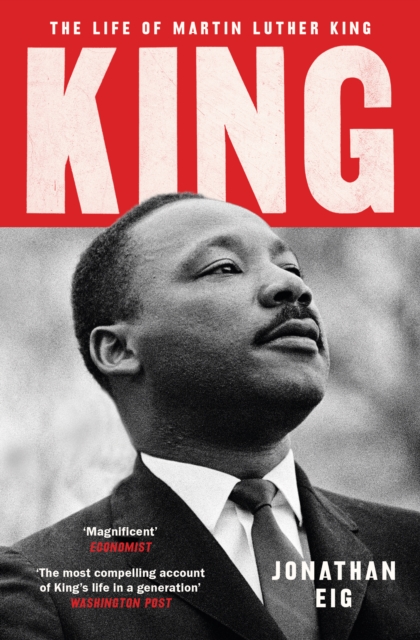
King
KSh 2,700.00
Caste
KSh 2,700.00
In the Wake
KSh 3,600.00

And So I Roar
KSh 2,000.00
Invisible Women
KSh 2,350.00

Africa''s Tarnished Name
KSh 700.00
Equality
KSh 2,150.00
Pedagogy of the Oppressed
KSh 2,000.00
Citizen
KSh 2,350.00

Winners Take All
KSh 2,350.00