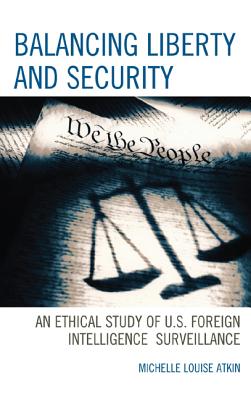
Balancing Liberty and Security : An Ethical Study of U.S. Foreign Intelligence Surveillance, 2001-2009
Book Details
Format
Hardback or Cased Book
ISBN-10
1442219092
ISBN-13
9781442219090
Publisher
Bloomsbury Publishing Plc
Imprint
Rowman & Littlefield Publishers
Country of Manufacture
US
Country of Publication
GB
Publication Date
Jul 11th, 2013
Print length
156 Pages
Weight
388 grams
Dimensions
23.70 x 15.30 x 1.60 cms
Product Classification:
Espionage & secret servicesHuman rights
Ksh 18,250.00
Manufactured on Demand
Delivery in 29 days
Delivery Location
Delivery fee: Select location
Delivery in 29 days
Secure
Quality
Fast
This work examines the philosophical foundations of information ethics and their potential for application to contemporary problems in U.S. foreign intelligence surveillance. Questions concerning the limits of government intrusion on protected Fourth Amendment rights are examined against the backdrop of the post-9/11 period. Changes to U.S. foreign intelligence surveillance law and policy are analyzed by applying the traditional ethical theories commonly used to support or discount these changes, namely utilitarian and contractarian ethical theories. The resulting research combines both theoretical elements, through its use of analytic philosophy, and qualitative research methods, through its use of legislation, court cases, news media, and scholarship surrounding U.S. foreign intelligence surveillance. Using the U.S.A. PATRIOT Act, the Foreign Intelligence Surveillance Act (FISA) and the Terrorist Surveillance Program as case examples, the author develops and applies a normative ethical framework based on a legal proportionality test that can be applied to future cases involving U.S. foreign intelligence surveillance. The proportionality test developed in this research, which is based on a modified version of the Canadian Oakes Test, seeks to balance legitimate concerns about collective security against the rights of the individual. As a new synthesis of utilitarian and contractarian ethical principles, the proportionality test laid out in this book has potential for application beyond U.S. foreign intelligence surveillance. It could act as a guide to future research in other applied areas in information policy research where there is a clear tension between individual civil liberties and the collective good of society. Problems such as passenger screening, racial and ethnic profiling, data mining, and access to information could be examined using the framework developed in this study.
Get Balancing Liberty and Security by at the best price and quality guaranteed only at Werezi Africa's largest book ecommerce store. The book was published by Bloomsbury Publishing Plc and it has pages.