
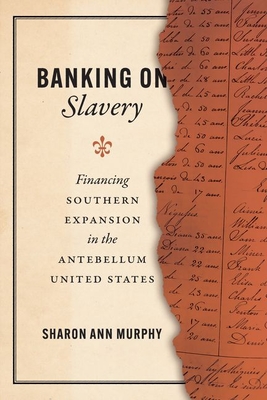
Banking on Slavery : Financing Southern Expansion in the Antebellum United States
Book Details
Format
Hardback
Book Series
American Beginnings, 1500-1900
ISBN-10
0226824594
ISBN-13
9780226824598
Publisher
The University of Chicago Press
Imprint
University of Chicago Press
Country of Manufacture
GB
Country of Publication
GB
Publication Date
Apr 5th, 2023
Print length
432 Pages
Weight
804 grams
Dimensions
23.60 x 16.20 x 3.50 cms
KSh 20,700.00
Currently unavailable
0 in stock
Delivery Location
Delivery fee: Select location
Secure
Quality
Fast
A sobering excavation of how deeply nineteenth-century American banks were entwined with the institution of slavery. It’s now widely understood that the fullest expression of nineteenth-century American capitalism was found in the structures of chattel slavery. It’s also understood that almost every other institution and aspect of life then was at least entangled with—and often profited from—slavery’s perpetuation. Yet as Sharon Ann Murphy shows in her powerful and unprecedented book, the centrality of enslaved labor to banking in the antebellum United States is far greater than previously thought. Banking on Slavery sheds light on precisely how the financial relationships between banks and slaveholders worked across the nineteenth-century South. Murphy argues that the rapid spread of slavery in the South during the 1820s and ’30s depended significantly upon southern banks’ willingness to financialize enslaved lives, with the use of enslaved individuals as loan collateral proving central to these financial relationships. She makes clear how southern banks were ready—and, in some cases, even eager—to alter time-honored banking practices to meet the needs of slaveholders. In the end, many of these banks sacrificed themselves in their efforts to stabilize the slave economy. Murphy also details how banks and slaveholders transformed enslaved lives from physical bodies into abstract capital assets. Her book provides an essential examination of how our nation’s financial history is more intimately intertwined with the dehumanizing institution of slavery than scholars have previously thought.
Get Banking on Slavery by Sharon Ann Murphy at the best price and quality guaranteed only at Werezi Africa's largest book ecommerce store. The book was published by The University of Chicago Press and it has 432 pages.
Customers Who Bought This Also Bought

Crusade for Justice – The Autobiography of Ida B. Wells, Second Edition
KSh 4,050.00

Killers of the Flower Moon
KSh 2,000.00

Warmth of Other Suns
KSh 3,050.00

Frederick Douglass
KSh 3,350.00

107 Days
KSh 4,500.00

Second Treatise of Government – Norton Library
KSh 1,600.00

Tuesdays With Morrie
KSh 2,000.00
My Bondage and My Freedom
KSh 1,600.00

Hidden Figures
KSh 2,000.00

America, América
KSh 3,650.00

Holding the Line
KSh 2,000.00

Nuclear Folly
KSh 3,050.00
More by Sharon Ann Murphy

Anglo-American Life Insurance, 1800–1914
KSh 90,000.00

Other People's Money
KSh 3,350.00

Anglo-American Life Insurance, 1800–1914
KSh 33,600.00

Investing in Life
KSh 10,450.00

Anglo-American Life Insurance, 1800-1914 Volume 2
KSh 30,950.00

Banking on Slavery
KSh 6,200.00

Anglo-American Life Insurance, 1800–1914 Volume 2
KSh 11,750.00

Other People's Money
KSh 8,000.00