
Book Details
Format
Paperback / Softback
ISBN-10
3662060264
ISBN-13
9783662060261
Edition
Eighth Edition 1987
Publisher
Springer-Verlag Berlin and Heidelberg GmbH & Co. KG
Imprint
Springer-Verlag Berlin and Heidelberg GmbH & Co. K
Country of Manufacture
DE
Country of Publication
GB
Publication Date
Sep 25th, 2013
Print length
249 Pages
Product Classification:
ChemistryOrganic chemistry
Ksh 9,200.00
Werezi Extended Catalogue
0 in stock
Delivery Location
Delivery fee: Select location
Secure
Quality
Fast
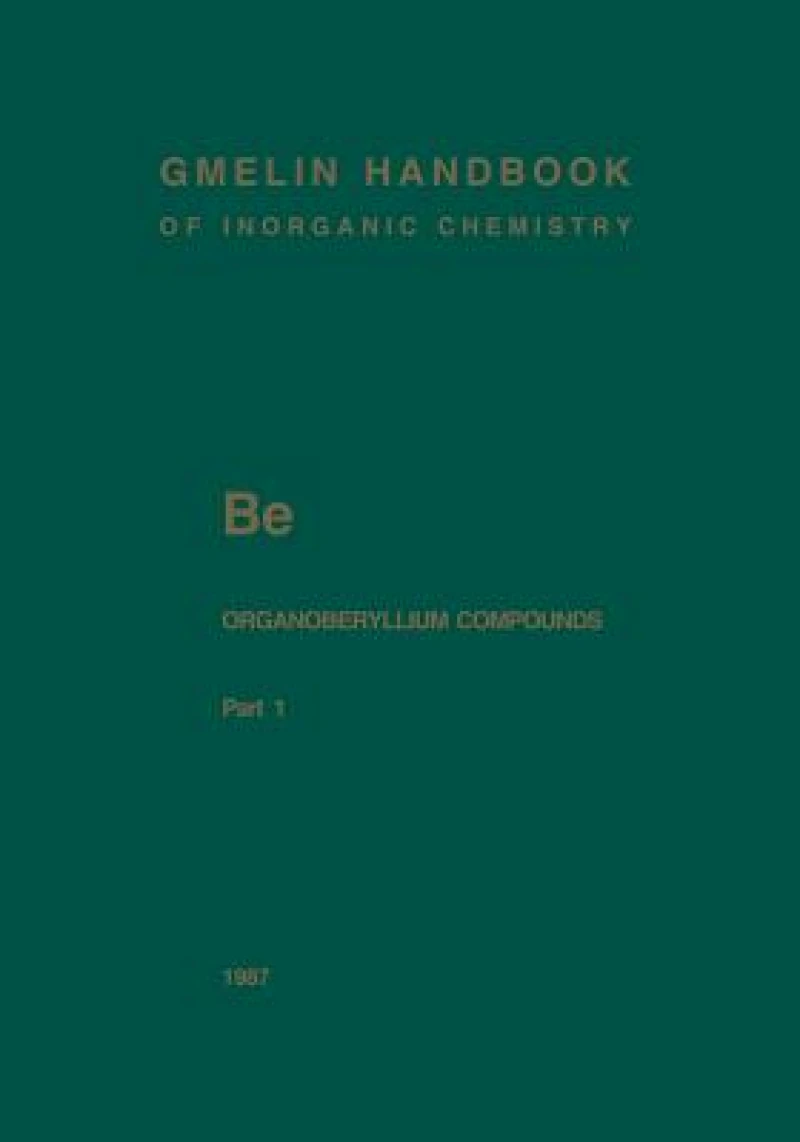
The present volume describes organoberyllium compounds containing at least one berylli um-carbon bond, except the beryllium carbides and cyanides. No doubt the main reason for the apparent ban of all experimental organoberyllium chemistry is to be found in the established, and alleged, hazardous properties of beryllium compounds.
The present volume describes organoberyllium compounds containing at least one berylli um-carbon bond, except the beryllium carbides and cyanides. It covers the literature com pletely to the end of 1986 and includes most of the references up to mid-1987. This Gmelin volume is different from all other volumes of the series on organometallic compounds in that it is dedicated to an area of research which has virtually come to a complete standstill. Organoberyllium chemistry has never been a very popular field, and only few workers have contributed to its slow growth, as is seen by the relatively small number of publications in the field. This very modest development became stagnant in the early 1970''s and was followed by a rapid decline. This exceptional fate of a branch of organometallic chemistry is only partly due to the very limited number of potential application~ of beryllium and its compounds. The compounds of this element are, in principle, at least as interesting and intriguing to scientists as those of other metals in the Periodic Table. No doubt the main reason for the apparent ban of all experimental organoberyllium chemistry is to be found in the established, and alleged, hazardous properties of beryllium compounds. Although similar hazards have been established for other organometallics where active research is still in process, e. g. , mercury and lead, these observations were absolutely lethaI for organoberyllium research.
Get Be Organoberyllium Compounds by at the best price and quality guaranteed only at Werezi Africa's largest book ecommerce store. The book was published by Springer-Verlag Berlin and Heidelberg GmbH & Co. KG and it has pages.

