
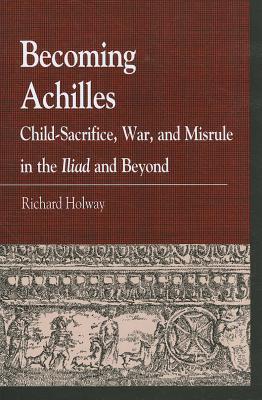
Becoming Achilles : Child-sacrifice, War, and Misrule in the lliad and Beyond
Book Details
Delivery Location
Delivery fee: Select location
Viewing the Iliad and myth through the lens of modern psychology, in Becoming Achilles: Child-Sacrifice, War, and Misrule in the Iliad and Beyond,Richard Holway shows how the epic underwrites individual and communal catharsis and denial. Sacrificial childrearing generates but also threatens agonistic, glory-seeking ancient Greek cultures. Not only aggression but knowledge of sacrificial parenting must be purged.
Just as Zeus contrives to have threats to his regime play out harmlessly (to him) in the mortal realm, so the Iliad dramatizes threats to Archaic and later Greek cultures in the safe arena of poetic performance. The epic represents in displaced form destructive mother-son and father-daughter liaisons and resulting strife within and between generations.
Holway calls into question the Iliad’s (and many scholars’) presentation of Achilles as a hero who speaks truth to power, learns through suffering, and exemplifies kingly virtues that Agamemnon lacks. So too the Iliad’s cathartic process, whether conceived as purging innate aggression or arriving at moral clarity. Instead, Holway argues, Achilles (and Socrates) try to prove they are not what at bottom they experience themselves to be—needy, defenseless children, who fear to acknowledge, much less speak out against, parents'' use of them to meet parents'' needs.
What emerges from Holway’s analysis is not only a new reading of the Iliad, from its first word to its last, but a revised account of the family dynamics underlying ancient Greek cultures.
Get Becoming Achilles by Richard Kerr Holway at the best price and quality guaranteed only at Werezi Africa's largest book ecommerce store. The book was published by Bloomsbury Publishing Plc and it has 270 pages.
Customers Who Bought This Also Bought
The Odyssey
KSh 1,800.00
The Odyssey
KSh 1,600.00
The Divine Comedy
KSh 2,350.00
Annals
KSh 2,350.00
Classical Literary Criticism
KSh 2,350.00
Great Dialogues of Plato
KSh 1,450.00
The Divine Comedy
KSh 2,700.00
The Iliad
KSh 1,800.00

The Masnavi, Book Six
KSh 2,000.00

The Masnavi, Book Five
KSh 1,800.00
Chaucer's Pardoner and Gender Theory
KSh 8,100.00
Classical Literary Criticism
KSh 1,800.00
