
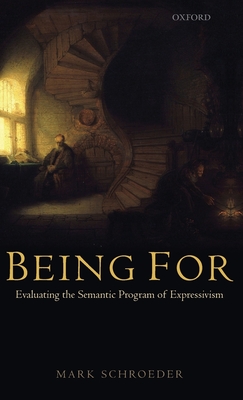
Being For : Evaluating the Semantic Program of Expressivism
Book Details
Format
Hardback
ISBN-10
0199534659
ISBN-13
9780199534654
Publisher
Oxford University Press
Imprint
Oxford University Press
Country of Manufacture
GB
Country of Publication
GB
Publication Date
Jun 5th, 2008
Print length
214 Pages
Weight
402 grams
Dimensions
22.20 x 14.50 x 2.00 cms
Product Classification:
Philosophy of languagePhilosophy: epistemology & theory of knowledgeEthics & moral philosophy
KSh 14,050.00
Temporarily out of stock, due soon
0 in stock
Delivery Location
Delivery fee: Select location
Secure
Quality
Fast
Mark Schroeder explores the semantic commitments of metaethical expressivism, the heir to the noncognitivist theories of Ayer, Stevenson, and Hare. He shows how to solve many of the open problems facing expressivism, but this only highlights further and deeper problems for the view. Expressivism, he argues, is coherent and interesting, but false.
Expressivism - the sophisticated contemporary incarnation of the noncognitivist research program of Ayer, Stevenson, and Hare - is no longer the province of metaethicists alone. Its comprehensive view about the nature of both normative language and normative thought has also recently been applied to many topics elsewhere in philosophy - including logic, probability, mental and linguistic content, knowledge, epistemic modals, belief, the a priori, and even quantifiers. Yet the semantic commitments of expressivism are still poorly understood and have not been very far developed. As argued within, expressivists have not yet even managed to solve the ''negation problem'' - to explain why atomic normative sentences are inconsistent with their negations. As a result, it is far from clear that expressivism even could be true, let alone whether it is.Being For seeks to evaluate the semantic commitments of expressivism, by showing how an expressivist semantics would work, what it can do, and what kind of assumptions would be required, in order for it to do it. Building on a highly general understanding of the basic ideas of expressivism, it argues that expressivists can solve the negation problem - but only in one kind of way. It shows how this insight paves the way for an explanatorily powerful, constructive expressivist semantics, which solves many of what have been taken to be the deepest problems for expressivism. But it also argues that no account with these advantages can be generalized to deal with constructions like tense, modals, or binary quantifiers. Expressivism, the book argues, is coherent and interesting, but false.
Get Being For by Mark Schroeder at the best price and quality guaranteed only at Werezi Africa's largest book ecommerce store. The book was published by Oxford University Press and it has 214 pages.
Customers Who Bought This Also Bought

Recognising the Stranger
KSh 1,800.00
The Origin of Language
KSh 4,500.00
Sharing Thoughts
KSh 17,000.00

An Inquiry Into Meaning and Truth
KSh 3,750.00
Semiotics and the Philosophy of Language
KSh 3,400.00
An Introduction to Logic
KSh 6,650.00

Walker Percy''s Search for Community
KSh 5,950.00
Film Figures
KSh 16,450.00

The Tacit Dimensions of Language and Logic
KSh 15,800.00

Metaphors in Action
KSh 21,600.00
Frontiers in Semiotics
KSh 3,000.00

A Theory of Death
KSh 11,900.00
More by Mark Schroeder

When Things Get Personal
KSh 3,600.00
Expressing Our Attitudes
KSh 16,300.00

Reasons First
KSh 4,550.00

Noncognitivism in Ethics
KSh 7,950.00

Noncognitivism in Ethics
KSh 30,950.00

Slaves of the Passions
KSh 22,150.00

The Fundamentals of Reasons
KSh 3,800.00

Reasons First
KSh 7,250.00
Explaining the Reasons We Share
KSh 15,200.00
Explaining the Reasons We Share
KSh 6,250.00

The Fundamentals of Reasons
KSh 15,950.00
