
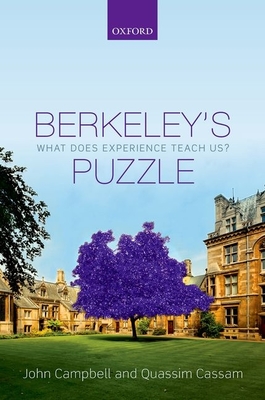
Berkeley''s Puzzle : What Does Experience Teach Us?
Book Details
Format
Hardback
ISBN-10
0198716257
ISBN-13
9780198716259
Publisher
Oxford University Press
Imprint
Oxford University Press
Country of Manufacture
GB
Country of Publication
GB
Publication Date
Aug 21st, 2014
Print length
224 Pages
Weight
492 grams
Dimensions
15.80 x 23.30 x 1.80 cms
KSh 15,850.00
Currently unavailable
0 in stock
Delivery Location
Delivery fee: Select location
Secure
Quality
Fast
Sensory experience seems to be the basis of our knowledge of mind-independent things. The puzzle is to understand how that can be: how does our sensory experience enable us to conceive of them as mind-independent? This book is a debate between two rival approaches to understanding the relationship between concepts and sensory experience.
Sensory experience seems to be the basis of our knowledge and conception of mind-independent things. The puzzle is to understand how that can be: even if the things we experience (apples, tables, trees etc), are mind-independent how does our sensory experience of them enable us to conceive of them as mind-independent? George Berkeley thought that sensory experience can only provide us with the conception of mind-dependent things, things which cannot exist when they aren''t being perceived. It''s easy to dismiss Berkeley''s conclusion but harder to see how to avoid it. In this book, John Campbell and Quassim Cassam propose very different solutions to Berkeley''s Puzzle. For Campbell, sensory experience can be the basis of our knowledge of mind-independent things because it is a relation, more primitive than thought, between the perceiver and high-level objects and properties in the mind-independent world. Cassam opposes this ''relationalist'' solution to the Puzzle and defends a ''representationalist'' solution: sensory experience can give us the conception of mind-independent things because it represents its objects as mind-independent, but does so without presupposing concepts of mind-independent things.This book is written in the form of a debate between two rival approaches to understanding the relationship between concepts and sensory experience. Although Berkeley''s Puzzle frames the debate, the questions addressed by Campbell and Cassam aren''t just of historical interest. They are among the most fundamental questions in philosophy.
Get Berkeley''s Puzzle by John Campbell, Quassim Cassam at the best price and quality guaranteed only at Werezi Africa's largest book ecommerce store. The book was published by Oxford University Press and it has 224 pages.
Customers Who Bought This Also Bought

Why I Am so Clever
KSh 700.00

A Treatise of Human Nature
KSh 2,700.00
On the Genealogy of Morals
KSh 2,000.00
Critique of Pure Reason
KSh 3,400.00
Beyond Good and Evil
KSh 2,000.00

Either/Or
KSh 2,700.00

Great Ideas Fear and Trembling
KSh 1,450.00
Outlines of the Philosophy of Right
KSh 2,500.00
Critique of Judgement
KSh 2,700.00

Prolegomena to Any Future Metaphysics
KSh 2,700.00

Kant – A Revolution in Thinking
KSh 4,500.00

An Answer to the Question: ''What is Enlightenment?''
KSh 1,450.00
More by John Campbell, Quassim Cassam

Complete Casting Handbook
KSh 23,400.00

How to Think About Terrorism
KSh 4,500.00

The Supercommentary on the Illuminating Lamp on the Esoteric Community Tantra
KSh 16,200.00

Pistols at Dawn
KSh 3,050.00
Vices of the Mind
KSh 6,100.00

Third Millennium Thinking
KSh 3,950.00

Haldane
KSh 6,050.00

Edward Heath
KSh 3,700.00

If Love Were All...
KSh 3,250.00
Nigeria
KSh 19,800.00

Third Millennium Thinking
KSh 3,050.00

The Martyr of Erromanga
KSh 4,200.00
