
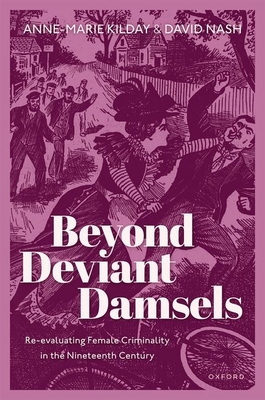
Beyond Deviant Damsels : Re-evaluating Female Criminality in the Nineteenth Century
Book Details
Format
Hardback
ISBN-10
0198830734
ISBN-13
9780198830733
Publisher
Oxford University Press
Imprint
Oxford University Press
Country of Manufacture
GB
Country of Publication
GB
Publication Date
Mar 28th, 2023
Print length
262 Pages
Weight
568 grams
Dimensions
16.40 x 24.00 x 2.30 cms
KSh 20,850.00
Currently unavailable
0 in stock
Delivery Location
Delivery fee: Select location
Secure
Quality
Fast
Beyond Deviant Damsels offers a new interpretation of women's criminality in the nineteenth century, countering assumptions that women commit crime in highly gendered ways and questioning the value of using stereotypes to analyse criminality, an approach that marginalises the importance of circumstances and individual choice.
Using detailed case studies, Beyond Deviant Damsels undermines many of the conventional assumptions about how women committed crime in the nineteenth century. Previous historical accounts generally constructed gendered stereotypes of women acting in self-defence, being lesser accomplices to male criminals, committing crimes that require little or no physical effort, or pursuing supposedly ''female'' goals (such as material acquisition). This study counters these gendered assumptions by examining instances where women tested society''s boundaries through their own actions, ultimately presenting women as far more like men in their capacity and execution of criminal behaviour. The book shows examples where women acted far beyond these stereotypes, and showcases the existence of cultural discussion of open-ended female misbehaviour in Victorian Britain - leading us to question the very role of stereotyping in the history of criminality. These individual challenges to a supposed gendered status quo in Victorian Britain did not produce spontaneous outrage, nor were attempts at controlling and eradicating such behaviour coherent or successful. As such Victorian society''s treatment of women emerges as uncertain and confused as much as it was determinedly moralistic. From this, Beyond Deviant Damsels seeks to re-evaluate our twenty-first-century perception of female criminals, by indicating that historiography may have been responsible for limiting the picture of Victorian female criminality and behaviour from that time until the present.
Get Beyond Deviant Damsels by Anne-Marie Kilday, David Nash at the best price and quality guaranteed only at Werezi Africa's largest book ecommerce store. The book was published by Oxford University Press and it has 262 pages.
Customers Who Bought This Also Bought

Age of Revolutions
KSh 2,350.00

Eichmann in Jerusalem
KSh 2,350.00

Trouble With Being Born
KSh 2,000.00

Hiroshima
KSh 2,000.00

Freedom
KSh 6,300.00

Holocaust
KSh 2,700.00
The History of the Peloponnesian War
KSh 2,700.00
Annals
KSh 2,350.00

Greek Lives
KSh 2,150.00
Sleepwalkers
KSh 3,400.00

Napoleon The Great
KSh 3,600.00
Diary of a Young Girl
KSh 1,800.00
More by Anne-Marie Kilday, David Nash

52 Prepper Projects
KSh 3,300.00
Shame and Modernity in Britain
KSh 12,600.00

Reverse Sod Swap
KSh 4,500.00

Blasphemy in Britain and America, 1800-1930, Volume 2
KSh 33,300.00

Large Print Cryptograms #2
KSh 2,500.00
Shame and Modernity in Britain
KSh 18,000.00

The Real Living Wage
KSh 18,200.00
Twmps
KSh 2,150.00

Blasphemy in the Christian World
KSh 18,000.00
Murder and Mayhem
KSh 5,050.00

The Islands of Chile
KSh 1,450.00

Guide to European Pressure Equipment
KSh 105,450.00
