
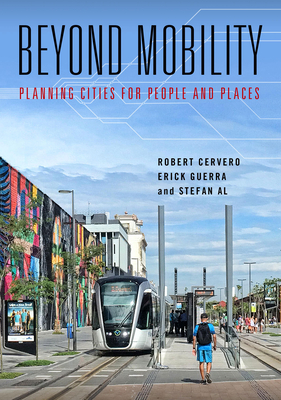
Beyond Mobility : Planning Cities for People and Places
Book Details
Format
Paperback / softback
ISBN-10
1610918347
ISBN-13
9781610918343
Publisher
Princeton University Press
Imprint
Island Press
Country of Manufacture
US
Country of Publication
GB
Publication Date
Dec 5th, 2017
Print length
296 Pages
Weight
620 grams
Dimensions
18.10 x 25.40 x 1.40 cms
Product Classification:
Urban & municipal planningUrban and municipal planning and policy
KSh 7,550.00
Werezi Extended Catalogue
Delivery in 12 days
2 copies in stock
Delivery Location
Delivery fee: Select location
Delivery in 12 days
Secure
Quality
Fast
Planning experts give global examples of cities that look beyond transportation to create better places.
Cities across the globe have been designed with a primary goal of moving people around quickly--and the costs are becoming ever more apparent. The consequences are measured in smoggy air basins, sprawling suburbs, unsafe pedestrian environments, and despite hundreds of billions of dollars in investments, a failure to stem traffic congestion. Every year our current transportation paradigm generates more than 1.25 million fatalities directly through traffic collisions. Worldwide, 3.2 million people died prematurely in 2010 because of air pollution, four times as many as a decade earlier. Instead of planning primarily for mobility, our cities should focus on the safety, health, and access of the people in them. Beyond Mobility is about prioritizing the needs and aspirations of people and the creation of great places. This is as important, if not more important, than expediting movement. A stronger focus on accessibility and place creates better communities, environments, and economies. Rethinking how projects are planned and designed in cities and suburbs needs to occur at multiple geographic scales, from micro-designs (such as parklets), corridors (such as road-diets), and city-regions (such as an urban growth boundary). It can involve both software (a shift in policy) and hardware (a physical transformation). Moving beyond mobility must also be socially inclusive, a significant challenge in light of the price increases that typically result from creating higher quality urban spaces. There are many examples of communities across the globe working to create a seamless fit between transit and surrounding land uses, retrofit car-oriented suburbs, reclaim surplus or dangerous roadways for other activities, and revitalize neglected urban spaces like abandoned railways in urban centers. The authors draw on experiences and data from a range of cities and countries around the globe in making the case for moving beyond mobility. Throughout the book, they provide an optimistic outlook about the potential to transform places for the better. Beyond Mobility celebrates the growing demand for a shift in global thinking around place and mobility in creating better communities, environments, and economies.
Get Beyond Mobility by Erick Guerra, Robert Cervero at the best price and quality guaranteed only at Werezi Africa's largest book ecommerce store. The book was published by Princeton University Press and it has 296 pages.
Customers Who Bought This Also Bought

Death and Life of Great American Cities
KSh 3,600.00

Frankenstein Urbanism
KSh 7,900.00

Contemporary Latin American Architecture
KSh 7,900.00

Contemporary Latin American Architecture
KSh 30,950.00
Company Towns in the Americas
KSh 5,400.00

Robert Royston
KSh 5,550.00

World Cities Report 2026
KSh 13,050.00

Night Rules
KSh 30,950.00

Climate Bridge – An International Perspective on How to Enact Climate Action at the Government Public Interface
KSh 17,300.00
George Washington's Washington
KSh 6,300.00

The Politics of Urban Water
KSh 14,050.00
Fighting Sprawl and City Hall
KSh 3,600.00
More by Erick Guerra, Robert Cervero

Dwelling on Earth – The Past and Future of the Places We Call Home
KSh 4,300.00

Overbuilt
KSh 5,050.00
Adapting Cities to Sea Level Rise
KSh 6,300.00
America''s Suburban Centers
KSh 6,850.00
Supertall – How the World's Tallest Buildings Are Reshaping Our Cities and Our Lives
KSh 2,900.00
America''s Suburban Centers
KSh 27,900.00

The Strip
KSh 6,300.00
